
Meta Pushes Wonder-Trained Models to Free Users: A Decision FAQ on Tiers, Metrics and Next Moves

Starting November 6, Meta is pushing specialized versions of the models it already runs — trained using its flagship Muse Wonder — out to Muse and Meta AI users, including those who pay nothing. For software decision-makers the answer to "what changed" is narrow: the two agent behaviours that made Wonder line interesting, Active Memory and Active Focus, now reach a mass audience, while Muse Wonder and the stronger Wonder Full stay inside paid subscriptions and developer access.
By Kai Brooks, GlobalSaaSManager — SaaS Industry News desk.
What exactly did Meta put in front of free users?
Not a shrunk flagship. The November 6 change is a batch of "specialized versions" of existing Meta models, produced with Muse Wonder as the training model. Meta has not released their names. What is defined is what they inherit: the two capabilities the Wonder series first introduced — Active Memory, which keeps and reuses user information over time, and Active Focus, which keeps a task moving when something goes wrong.
"With Muse Wonder, we introduced Active Memory and Active Focus. We're bringing both of these to our specialized models in Muse and Meta AI," Meta AI Research wrote in the launch post, Bringing Specialized Models to Muse and Meta AI.
Two earlier dates frame the commercial question. In October 2026, Meta released Muse Wonder and the more powerful Wonder Full: Wonder was connected to Meta Model API and the Muse Code coding assistant, while Wonder Full was reserved for Muse Code's high-end paying users. Then, in September this year, Meta launched Muse, its personal assistant app. Muse ships with a free usage tier — a deliberate contrast with rival products whose comparable agents are limited to premium subscribers.
Why retrain instead of simply distilling a smaller model?
Because the scarce ingredient is behaviour, not knowledge. Rather than publish a reduced Wonder, Meta retrained around the way consumer assistants are actually used: when an agent should execute on its own, when it should stop and check with the user, and how to hold context together when the user corrects it mid-task.
Distilling a large model into a smaller one to serve more users at lower cost is standard industry practice. Meta did not disclose its specific training recipe, but stressed that these builds are optimised for personal-assistant demands rather than broader general-knowledge coverage. The company's stated view is that a strong personal agent should book a restaurant table, manage an inbox, remember something the user mentioned a week earlier, and keep working when a website fails or a task is interrupted — without carrying the full knowledge load of a frontier model.
How much better is memory and recovery, in Meta's own numbers?
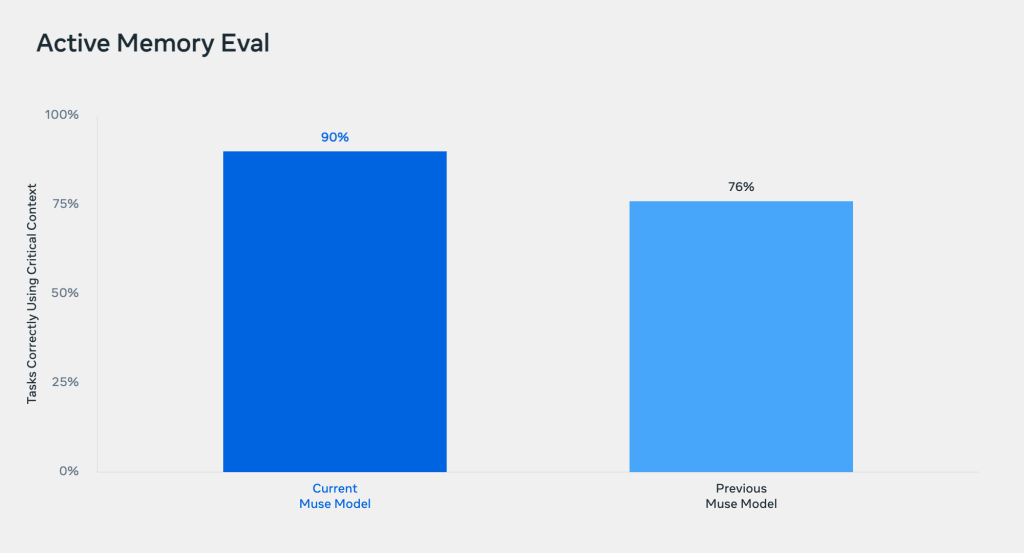
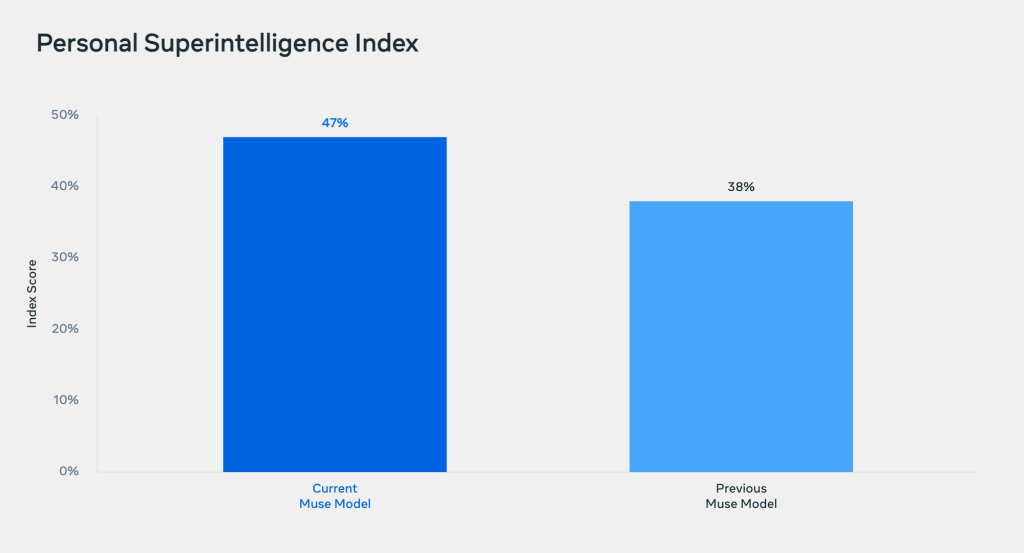
Every published figure so far comes from Meta. Alongside the 90% versus 76% context-usage result the company disclosed, Meta's launch post reports that the current Muse model scores 47% on its Personal Superintelligence Index against 38% for the previous generation, and the specialised builds are said to be 2.4x less likely to forget critical information.
| Measure | Previous generation | Specialized models | Status of the number |
|---|---|---|---|
| Correct use of key context while a task is running | 76% | 90% | Meta internal test |
| Completing routine tasks when an unexpected problem appears | baseline | +67% | Reported inside the Muse app; no benchmark published |
| Personal Superintelligence Index score | 38% | 47% | Meta-defined index, self-reported |
Meta has not published the underlying benchmark for these models, which is why GlobalSaaSManager treats the deltas as direction, not procurement evidence. The buying question is not whether 90% beats 76%, but whether fewer stalls reduce total workflow cost. As analysts at Digital Applied put it in a 2026 review of enterprise agent deployments, "a lower model price does not automatically yield a lower cost per accepted task if the surrounding workflow needs more review or recovery work" (AI Agent Adoption 2026). Memory and focus attacks precisely that hidden cost line: the rework humans absorb when an agent forgets or freezes.
Which tier do you actually need? The model map
| Model | Access | Designed for | How it is billed |
|---|---|---|---|
| Muse Wonder | Flagship, kept for paying subscription users; open to developers through Meta's model interface | More complex, higher-difficulty tasks | Charged per input and output token |
| Wonder | Already integrated into Meta Model API and the Muse Code coding assistant | Developer and coding-agent workloads | API and product usage |
| Wonder Full | Only Muse Code's high-end paying users | The hardest, longest-running jobs | Inside the premium subscription |
| New specialized models | Muse and Meta AI users, free tier included | Personal-assistant jobs: remembering, recovering, continuing | Bundled in the assistant products |
One price reference outside the launch materials: CNBC reported on October 12, 2026 that Muse app users who want Wonder itself inside the assistant must take a paid plan, which the network listed at $20 or $100 a month (CNBC coverage). Read that as consumer-tier context for the same product family, not as a statement Meta attached to the November 6 rollout.
Scale is the other half of the strategy. Meta AI is already embedded across WhatsApp, Instagram, Facebook and Messenger, so a specialised model that is cheaper per interaction can serve a very large audience, which is more economical than routing every user to the flagship. The pattern for the industry: train narrow, task-shaped models on frontier teachers, then ship them into consumer products.
Five moves for founders, product leads and buyers this month
- Re-cut your own free-versus-paid line. Meta's split is a product lesson, not a procurement decision: give memory and recovery behaviour away to drive habit, and reserve multi-step, high-difficulty execution for paid tiers.
- Instrument cost per completed task, not cost per token. Track the 67%-style recovery metric on your side — how many agent runs need human repair — before you move workloads between tiers.
- Inventory what your assistant is allowed to remember. Active Memory makes retention a product feature; write down the data classes you are comfortable keeping across sessions, and how users delete them.
- Put a human gate on irreversible actions. Governance guides for agentic systems recommend pausing for explicit approval before payments, deletions or production changes, a requirement reinforced by the EU AI Act and comparable rules (Dataversity, Agentic AI Governance).
- Watch the surface count, not just the model. Meta is widening where agents live: the same assistant gained real-time voice interaction, which we unpacked in our case review of the Muse Voice update. For budget and capability context on Meta's wider AI build-out, see our Q&A on Meta's AI productivity bet.
FAQ: short answers SaaS teams are searching for
Is Muse Wonder free now?
No. What reaches free users on and after November 6 is a set of specialized versions trained with Muse Wonder. Muse Wonder itself remains for paying subscription users handling more complex tasks, plus developers billed per input and output token; Wonder Full remains exclusive to Muse Code's high-end paying users.
Did Meta name the new models or publish an evaluation sheet?
Neither. The names have not been disclosed, and the company released no external benchmark for the specialised builds — only internal results such as the 90% versus 76% context use and the 67% everyday-task improvement.
Can we call these specialised models through an API?
The announcement as covered here describes them serving Muse and Meta AI users. Developer access described in the same materials runs through Meta Model API, where Wonder is already integrated; nothing published so far puts the specialised builds behind that interface.
Should we switch our everyday assistant because memory got better?
Only if the memory failure mode was your bottleneck. Test on your own workload: recurring instructions, multi-day continuity, and recovery after a tool breaks. Meta's 47% versus 38% index movement suggests meaningful, not categorical, change.
Does this reshape the competitive map with OpenAI and Anthropic?
It shifts where the fight happens. Meta is competing on distribution plus cheaper capability per interaction across WhatsApp, Instagram, Facebook and Messenger, rather than on raw flagship access for everyone.
What we would flag as risk (GlobalSaaSManager analysis)
This section is our assessment, not a Meta statement. First, the numbers that matter most are the least verifiable: index scores, self-correction rates and memory gains are all vendor-reported, so third-party replication is the trigger for any vendor switch. Second, persistent memory raises the sensitivity of what a consumer assistant stores, which transfers privacy exposure from a chat transcript to a growing personal profile. Third, the tier boundary is a live commercial variable — capability moved from paid to free in one release can be re-tiered in another, so contracts should never assume that "included today" means "included next quarter".
The practical takeaway is procedural rather than dramatic. Meta's November 6 rollout tells operators that frontier-grade agent behaviour is becoming a distribution play: cheap, memorable, self-recovering assistants for everyone, with the hardest reasoning kept behind a paywall. Teams that measure recovery cost now, and that document what their agents remember and may do unattended, will be able to price that shift instead of being surprised by it.
Reference sources
- Meta AI Research — Bringing Specialized Models to Muse and Meta AI: https://research.meta.ai/blog/specialized-models-for-muse-and-metaai
- Mark Zuckerberg on X, on the specialised Muse models and memory/self-correction gains: https://x.com/finkd/status/2118767522782626104
- CNBC — Meta debuts Muse Wonder AI model (October 12, 2026): https://www.cnbc.com/2026-10-12/meta-muse-wonder-ai-model-agent.html
- Digital Applied — AI Agent Adoption 2026: Enterprise Evidence and Limits: https://www.digitalapplied.com/blog/ai-agent-adoption-2026-enterprise-data-points
- Dataversity — Agentic AI Governance for Enterprise Teams (2026): https://www.dataversity.net/articles/agentic-ai-governance-enterprise-autonomous-systems/
- GlobalSaaSManager SaaS Industry News desk reporting on Meta AI