
Should You Rework Search Discovery for Google's AI Mode Sidebar? A SaaSIndustryNews FAQ | GlobalSaaSManager
Short answer: yes — but scope the change to discovery, not your whole funnel. The two-way door facing every product lead this quarter is whether to keep tuning for one-shot queries or rebuild for a session that refuses to end. The available evidence favors the second bet, at small scale. Here is what changed in Google Search, who it touches, and which experiments are worth running before you move a dollar of budget.
The trigger is a remark from Google Search product lead Robby Stein: the questions people bring to Google are increasingly not "ask once and done" ones. From testing, he says, the new panel helps people push a task forward and keep exploring the web — "a simpler way to pick up where you left off," in his words. That is a product-decision signal, not a cosmetic refresh. It says the unit of search is becoming a session rather than a single query, and it arrives after a year in which AI Mode itself scaled fast.
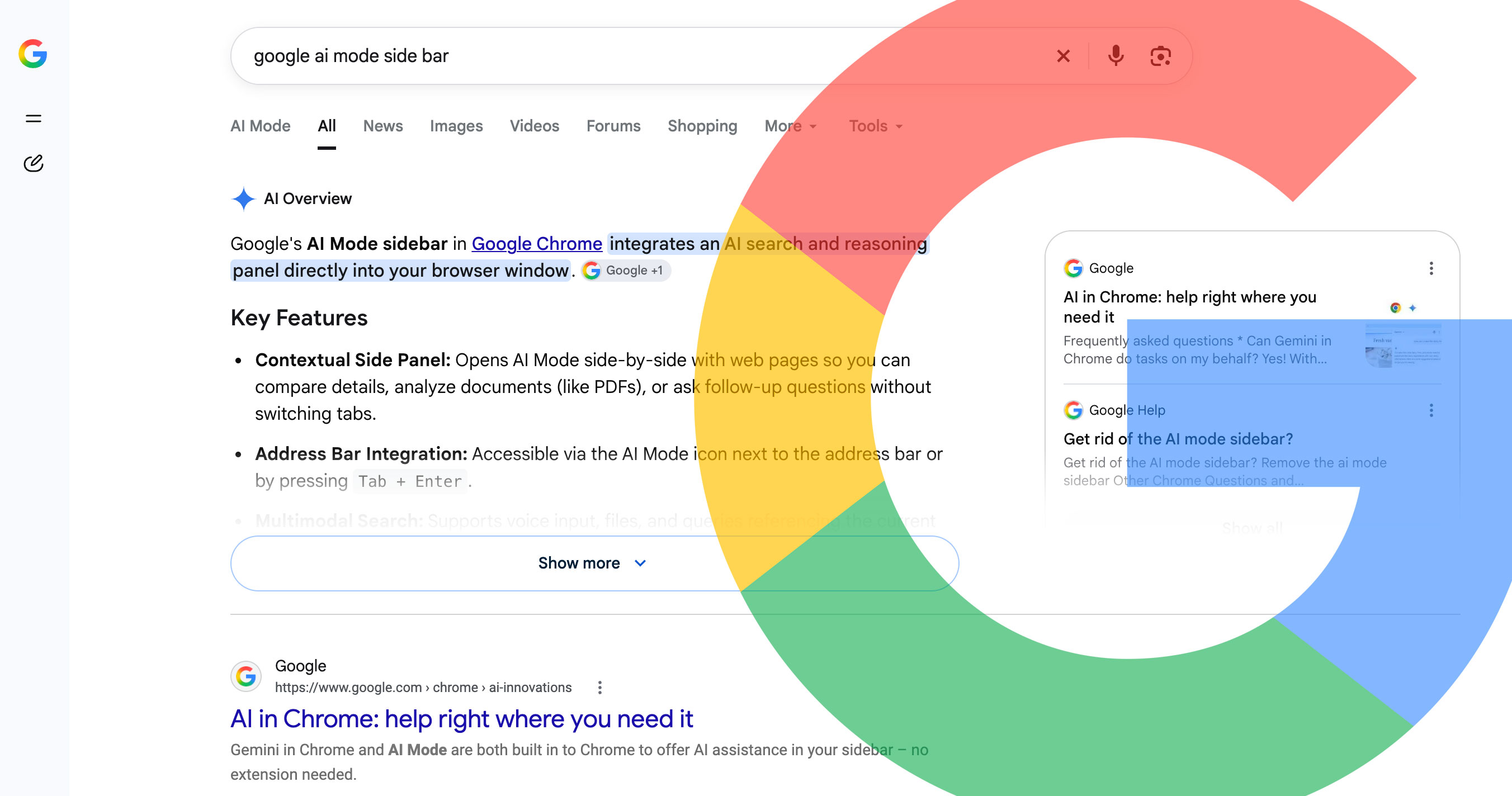
What changed in Google Search, in plain terms?
Conclusion: the results page is becoming a persistent workspace, and that moves the "which tool do I use" decision upstream. At the center is the AI Mode sidebar — a left-hand panel that keeps a thread alive across follow-ups. People outside Google had already noticed it and given it that name. One industry observer reported spending about three weeks in the experience and seeing the AI Mode sidebar on the left of Google's main search results page; the feature has not been fully opened to all users. So plan for partial coverage, not a switch that flipped overnight.
The broader rollout is documented. In Chrome, Google says, clicking a link can open the destination page side by side with AI Mode, which the company presents as making relevant sites easier to visit (Google's own April 2026 product post). On November 20, 2026, Stein announced a collapsible sidebar on the desktop homepage for finding and resuming recent AI searches (The Verge). Put those next to the original report's observation and the direction is unambiguous: fewer dead-end queries, more continued sessions.
Is the "more queries" claim actually supported?
Conclusion: directionally yes, but as a hypothesis with a measurable proxy, not a proven fact. The original analysis is that this interface change may not win over every user, yet it could prompt more search queries and raise Google AI Mode usage. Two external data points make that testable. At I/O 2026 in May, Google said AI Mode had passed 1 billion monthly active users, and subsequent reporting found planning-related queries growing about 80% faster than AI Mode queries overall across six months (CMSWire). Gemini 3.5 Flash became the default model powering AI Mode at that same event (Search Engine Land), so the sidebar is model-backed rather than a layout tweak. Caveat: user scale does not prove the sidebar caused the extra queries.
What does this mean for PLG, ACV and NRR?
Conclusion: it compresses raw visits but concentrates intent, so judge the change by shortlist quality, not click volume. Definitions first, because these abbreviations get used loosely. PLG (product-led growth) is a go-to-market motion in which the product itself drives acquisition, activation and expansion. ACV (annual contract value) is a single customer's yearly contract value. NRR (net revenue retention) is revenue retained from existing customers — expansion included, churn subtracted.
When a sidebar carries context across turns, the assistant — not a list of links — frames the shortlist. If your category gets named inside that framing, you may see fewer top-of-funnel clicks but better-qualified demos; if it does not, you vanish before a comparison page ever loads. That is why any ACV or NRR effect arrives late, through which vendors make the shortlist and which ones survive renewal. For SaaS buyers the practical read is identical: evaluation criteria need to be legible to an answer engine, not only to a human scanning ten links.
| Signal | Old assumption | Sidebar-era assumption | Metric to watch |
|---|---|---|---|
| User enters a query | One query equals one answer | Query starts a multi-turn task | Sessions per visitor |
| Discovery point | Results-page ranking | Assistant-framed shortlist | Share of category mentions |
| Commercial effect | Clicks into pipeline | Shortlist into ACV and NRR | Qualified demo rate |
Where should budget move, and what should we test first?
Conclusion: don't reallocate outright — run two small experiments and let the data decide. The temptation is to cut search spend, and there is a real backdrop for it: search ad growth slowing to 12% has already pushed some advertisers toward Meta and ChatGPT. But a sidebar that keeps users inside a session changes discovery, not necessarily paid intent. Cutting the channel that still captures high-intent demand before you have a control group is how teams confuse a signal with a cause.
- Audit category phrasing: rewrite three landing pages to answer "how does," "what is" and "why does" prompts, then compare assisted conversions over 30 days.
- Instrument multi-turn paths: tag visits arriving after a follow-up query, and measure sessions per visitor plus qualified demo rate instead of raw clicks.
- Run a controlled paid test: hold search budget flat for one quarter, shift 10% into an AI-surface pilot, then compare ACV of closed-won deals.
- Check the renewal side: sample last quarter's churn interviews for "never shortlisted" language — that is where NRR leaks first.
What are the governance risks?
Conclusion: the bigger risk is loss of control, not loss of traffic. When AI features are fused into search, enterprises cannot always disable them for a specific use case — a live dispute over schools being unable to disable search AI features shows how that lands in procurement. The feature also remains not fully open to all users, which complicates any vendor claim that "everyone sees it." For IT administrators, an enterprise policy covering the address-bar AI mode setting is the available control point; treat it as a lever to review with security, not a universal fix.
FAQ: the four decisions readers actually ask about
1. Is the AI Mode sidebar live for everyone?
No. It is not fully open to all users; the observer in the original report saw it after about three weeks of use, and the global desktop rollout was announced on November 20, 2026. Keep a non-AI measurement baseline so partial coverage does not skew your data.
2. Will it really increase query volume?
Likely, but indirectly. More continued sessions and planning-style tasks generate more queries, and the analysis says Google AI Mode usage could rise. Track sessions per visitor rather than assuming a fixed query count per visit.
3. Should we rewrite SEO content now?
Yes, but narrowly. Prioritize direct-answer openings and question-style phrasing, then A/B three pages. Do not rebuild the entire content library before assisted conversions move.
4. Do we need to change paid strategy this quarter?
Not yet — run the 10% pilot first. With the well-documented slowdown in search advertising growth, a rebalance toward Meta and ChatGPT is defensible, but keep a control group so ACV changes can be attributed.
Next experiment: instrument the multi-turn path, hold paid search flat for one quarter, and read shortlist and ACV data in 30 days. That is the smallest test that turns this news into a decision.
About the author: Cleo Howard is a SaaS product lead writing for GlobalSaaSManager's SaaSIndustryNews desk. Contact: info@globalsaasmanager.com.
References
- Google, "A new way to explore the web with AI Mode in Chrome" (April 16, 2026) — https://blog.google/products-and-platforms/products/search/ai-mode-chrome/
- Google, "A new era for AI Search," I/O 2026 (May 19, 2026) — https://blog.google/products-and-platforms/products/search/search-io-2026/
- The Verge, "Google is putting AI chats right on the homepage" (November 20, 2026) — https://www.theverge.com/tech/1038059/google-search-homepage-ai-chats
- CMSWire, "What Did 1 Billion Google AI Mode Users Search for Over Past Year?" (May 22, 2026) — https://www.cmswire.com/digital-experience/what-are-1-billion-google-ai-mode-users-searching-for/
- Search Engine Land, "Google Search now powered by Gemini 3.5 Flash" (May 19, 2026) — https://searchengineland.com/google-search-now-powered-by-gemini-3-5-flash-477975