
U.S. Enterprise AI Spend Watch: 89% of Open-Source Model Dollars Flow to Chinese Models
United States enterprises are sending 89% of open-source AI model spending to Chinese models, according to Menlo Ventures’ recently released 2026: The State of Enterprise AI report. The finding comes from nearly 400 American AI buyers responsible for more than $4 billion in spend, and it matters because cheap tokens are becoming a procurement decision, not just an engineering choice.
Compare two suppliers in the same market: Moonshot AI’s Kimi holds 61% of United States enterprise open-source model spend, while Meta Llama holds 7%. The gap is not a rounding difference. It shows where buyers are moving budgets when they can download weights, fine-tune them and reduce dependence on a narrow set of closed model vendors.
What did the report measure, and why is 89% not total AI spend?
The number is narrow but important. Menlo Ventures measured spending on open-source large models used by enterprises in the United States. It did not say that 89% of all enterprise AI budgets go to China. The sample included nearly 400 American AI business leaders whose teams controlled more than $4 billion in AI spend. Menlo Ventures, a Silicon Valley firm with a 50-year investment history, has backed Anthropic and Uber.
For a SaaS leader, the useful reading is this: a small share of one budget line has concentrated among a few Chinese suppliers. The question is not whether every company will use a Chinese model, but whether procurement, architecture and risk teams have a policy for the price-quality curve that is now pulling the open-source market.
Which models captured the spend, and how concentrated is it?
The report places the top three models in United States enterprise open-source spending as Chinese models. Kimi, from Moonshot AI, accounts for 61%. DeepSeek takes 15% and GLM takes 11%, according to the report. That gives buyers a second and third option while leaving one vendor dominant. Among Western open-source models, Meta Llama reaches the highest share at 7%.
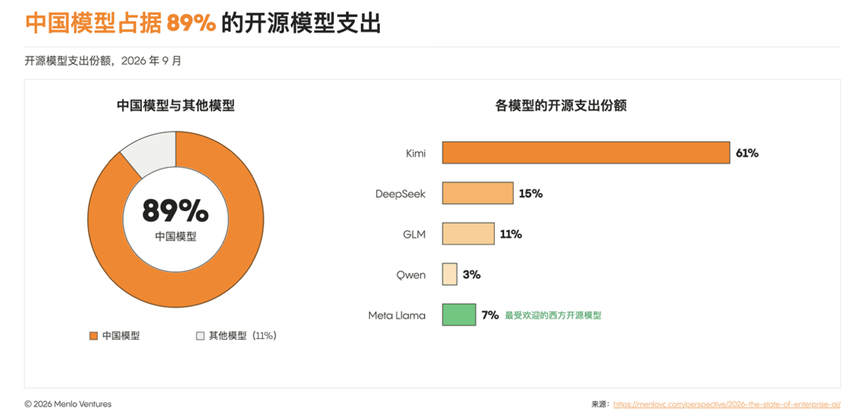
| Model or group | Reported share of United States enterprise open-source model spend | Buyer implication |
|---|---|---|
| Kimi, Moonshot AI | 61% | High concentration; test fallback paths. |
| DeepSeek | 15% | Secondary option for price and workflow fit. |
| GLM | 11% | Useful comparison in enterprise evaluation. |
| Meta Llama | 7% | Leading Western alternative, but far behind the top group. |
Why did Chinese models become the default?
Price mattered, but price alone rarely changes enterprise architecture. Menlo Ventures put it directly in the report: “As Chinese models define the frontier of open source, they account for 89% of open-source spending.”
Open-source models are downloadable model weights that enterprises can tune for their own tasks. Instead of training a base model from scratch, a product team can start from an existing model, continue training or fine-tuning, and adapt it to business constraints. This reduces time, compute and capital, while also lowering dependence on a few closed vendors. The ability frontier matters: if an open model is good enough for coding, support, search or document tasks, low price makes adoption easier.
Over the past year, the average token price for open-source models fell by two-thirds, from $0.45 per million to $0.13 per million. At the same time, usage rose 22.5 times, bringing monthly token calls to 2,900 trillion. The broader spending pool is also larger: Menlo Ventures reported enterprise AI deployment spending rising from $33 billion to $177 billion, so even a small share of a budget line can move real money.
What should managers take from the price-volume gap?
Open-source models handled 19% of platform tokens, but took only 4% of model spend. This is the most useful signal for finance-minded buyers: high volume does not equal high budget, and low budget does not equal low risk.
- Token price: the cost of a million model tokens, usually visible on a provider invoice or usage dashboard.
- Token volume: how much work a product sends through a model, often shaped by traffic growth, agent loops and longer context.
- Total cost of ownership: token price plus evaluation, migration, safety work, latency tuning, compliance review and human backup paths.
A supplier can be cheap per token and still expensive when engineering teams have to rebuild prompts, maintain private deployments, handle model drift or prove that outputs are acceptable for regulated workflows.
What actions should SaaS and enterprise software buyers take now?
- Run a supplier concentration test: if one model vendor or one model family carries most AI traffic, document what happens if pricing, availability or compliance status changes.
- Separate token price from total cost: compare $0.13 per million tokens against the cost of maintaining a routing layer, evaluation suite and fallback model.
- Review legal and data-transfer exposure before adopting open-source weights: understand whether weights are modified, hosted internally, sent to third-party clouds or fine-tuned on sensitive data.
- Build a model routing layer where possible: keep the application logic independent from any single model, so a price change or share shift does not force a rewrite.
- Track capability, not only share: use task-specific tests, quality, latency and cost per successful outcome, not a single headline benchmark.
FAQ: Reading the Menlo Ventures AI spend report as a manager
Does 89% mean most enterprise AI budgets in the United States go to China?
No. The 89% figure refers to open-source model spending within United States enterprises, not total enterprise AI spending and not all closed-model budgets.
Why is Kimi’s 61% share worth watching?
A 61% share in one model family means United States buyers are not merely sampling Chinese open-source options. They are concentrating real budget with one supplier, which affects pricing power, dependency and risk review.
Can a SaaS company replace a closed model with an open-source Chinese model?
It can try, but the decision should be made like a supplier switch: evaluate quality, latency, security, data handling, fine-tuning cost and support. Price alone is not proof of fit.
What is the biggest procurement risk?
Concentration plus opacity. If a team buys a cheap token stream without measuring model routing, compliance and total cost, the invoice may fall while operating risk rises.
A reminder for founders
Lucas Anderson’s read: if two products use the same task, one on a closed API and one on an open-source Chinese model, the gap will show up in three years in gross margin, switching cost and incident exposure, not in the headline model name. Treat the 89% figure as a supply-chain signal, not a trophy for low price.
Reference sources
- Menlo Ventures: 2026: The State of Enterprise AI
- Menlo Ventures report data: United States enterprise open-source model spending shares, average token price, monthly token calls and survey sample.