
Trimble WorksManager Drone Puts Cloud Photogrammetry Inside Trimble Connect: What the January 2027 DJI and Wingtra Launch Signals
Analysis by Kai Brooks, SaaSIndustryNews desk — GlobalSaaSManager. Editorial contact: info@globalsaasmanager.com
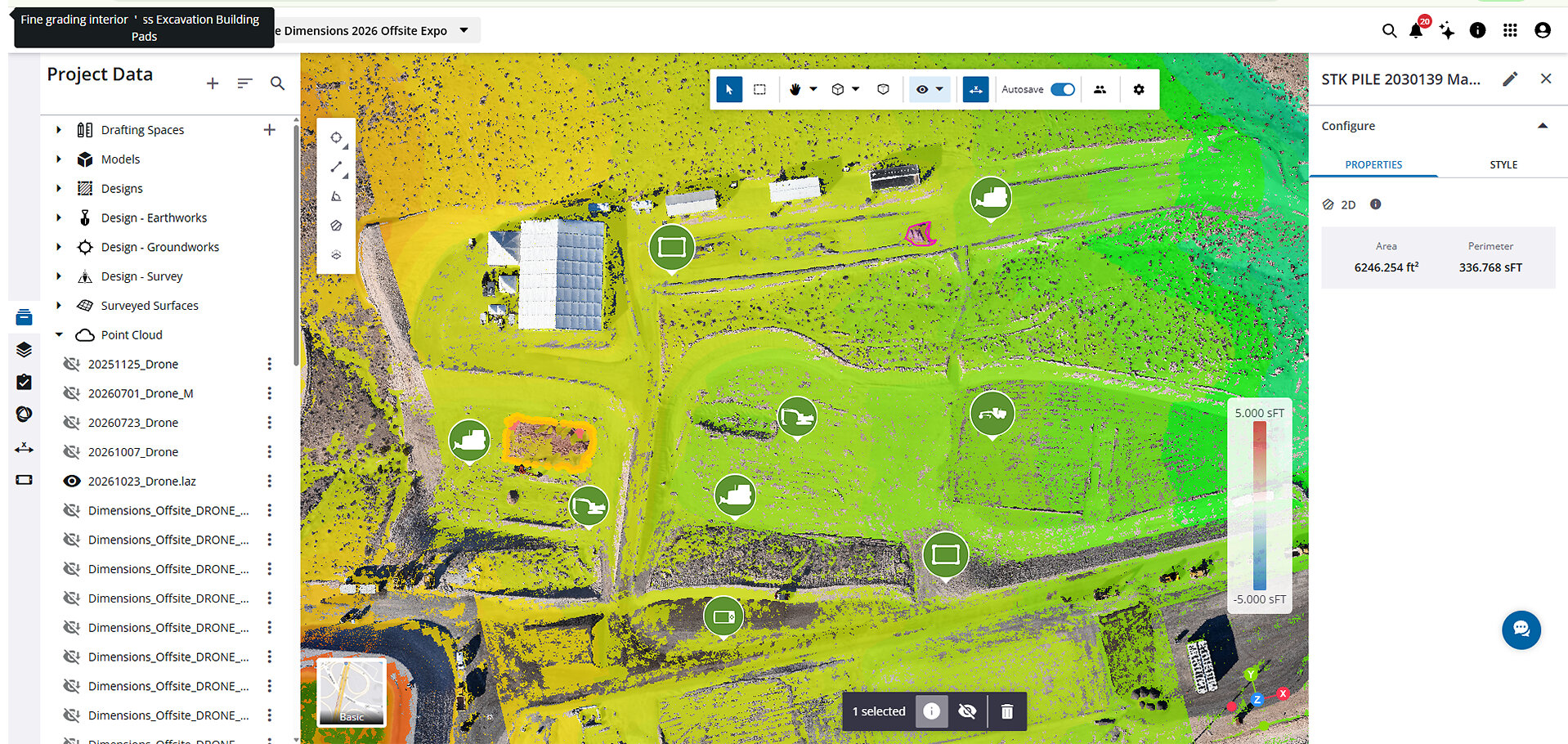
The value pool in contractor drone work is moving from flying the aircraft to owning the processing step, and Trimble has just moved its flag there. The newly announced Trimble WorksManager Drone runs photogrammetry in the cloud inside the same environment that already holds designs, machine data and as-builts, with availability expected in January 2027 through Trimble's global dealer channel for DJI and Wingtra aircraft. For founders, investors and software buyers, the read-through is structural: an outsourced, compute-heavy task is being absorbed into a subscription platform.
News at a glance
- What: Trimble WorksManager Drone, a cloud drone-data-processing module that extends Trimble Connect, the unified construction platform spanning the design-build-operate lifecycle.
- Method: photogrammetry that fuses flight data with project designs, machine data and as-builts to calculate volumes, take measurements and verify materials as site progress is tracked.
- When: expected in January 2027, sold through Trimble's dealer channel rather than a direct self-serve checkout.
- Hardware scope at launch: planned for use with DJI and Wingtra drones.
- First live showing: product and customer sessions with live demonstrations at the Trimble Dimensions User Conference 2026 in Las Vegas, which Trimble's own event page dates to November 9–11, 2026 at The Venetian Resort.
What does Trimble WorksManager Drone actually do?
In one line: it deletes an export-and-reimport loop. Site supervisors and project managers get drone results beside the latest design files and machine data, instead of a separate processing service that hands back files someone must then drag into the project record.
The mechanics are those of any cloud photogrammetry pipeline, but the placement is the point. As a cloud-based software and data management tool, Trimble WorksManager links the construction jobsite to the office; WorksManager Drone puts aerial computation on that same link. Trimble frames the capability in its own release as software that "turns flight data into actionable site data — all from one integrated and connected platform" (Trimble newsroom, Nov 5, 2026).
Field teams are already close to this pattern. In a flood-defence project reported by Chinese construction trade press, ASN drone project manager Anthony Herman described surveyors pulling high-resolution deliverables from Trimble Stratus and passing them through Trimble Connect into WorksManager or WorksOS, with checks pushed straight to a field controller and no download-and-convert step (d1cm.com). WorksManager Drone pushes that logic one stage further upstream, to the raw flight data itself.
Why is this a software business story rather than a drone story?
Because the money in this company has already migrated to recurring lines. Trimble closed fiscal 2025 with record annualized recurring revenue of $2.39 billion, up 6% year over year and 14% organically, on fourth-quarter revenue of $969.8 million (Trimble Q4/FY2025 results, Feb 10, 2026). In the first quarter of 2026, the company reported ARR of roughly $2.43 billion, up 12%, with subscription and services revenue near $629 million and full-year 2026 revenue guidance of $3,835–$3,915 million (Trimble investor relations).
Pricing is the other half of the story, and here the numbers are not yet public. Trimble's published list prices for Trimble Connect run from US$12.99 per user per month for Core collaboration tools to US$23.95 per user per month for Business Premium, with regional pricing set by distributors (Trimble Geospatial subscription plans). That tells you the platform's default shape is per-seat. Aerial processing is nothing like a seat: it is compute and storage consumed per flight. Our analysis — and this is inference, not vendor guidance — is that WorksManager Drone is where buyers should expect a usage or capacity layer to appear, because per-seat logic cannot price a photogrammetry cluster honestly.
Why now: regulation and data volume are pushing the bottleneck
The constraint is no longer getting aircraft airborne; it is what happens to the gigabytes afterwards. In June 2025, Executive Order 14307, "Unleashing American Drone Dominance," directed the FAA to issue a proposed rule enabling routine beyond-visual-line-of-sight operations within 30 days, with a final rule targeted within 240 days; the proposed Part 108 rule for routine BVLOS remains in progress and is not yet in effect (FAA, BVLOS). If routine BVLOS lands, flight hours per corridor rise sharply and the differential moves to processing throughput and data governance.
Market sizing points the same way. The construction drones market is estimated at US$8.06 billion in 2026, growing at an 11.81% CAGR to US$14.09 billion by 2031 (Mordor Intelligence), while the drone mapping and GIS services layer is forecast to climb from US$552.7 million in 2026 to US$2,545.2 million by 2036 at a 16.5% CAGR (Fact.MR). The services layer is compounding faster than the airframes — which is precisely the margin a platform vendor can capture by owning processing.
What does the January 2027 date mean for procurement?
Treat the announcement-to-availability gap as a test window, not a waiting room. Roughly two months separate the 2026 disclosure of the product from its January 2027 release, and that window collides with FY2027 budget lock for most civil contractors. Practical implications:
- Budget owners should decide now whether aerial processing is a line item inside an existing platform subscription or a separate third-party contract renewing mid-year.
- Dealer-channel availability means price and entitlement are negotiated, not read off a webpage; ask for storage ceilings, per-project compute caps and renewal uplift in writing.
- Demo discipline: the Las Vegas sessions in November 2026 are the cheapest look at throughput you will get before general availability. Bring a real site dataset, not a vendor sample.
- Run one parallel cycle — current processing route versus the new module — before you standardise, and check that volumes reconcile to the survey-of-record.
DJI and Wingtra: compatibility is not the same as supply
Launch scope is planned around DJI and Wingtra, which protects the dominant installed base of airframes while nodding to the fixed-wing mapping segment. The cross-market wrinkle is regulatory rather than technical. DJI was added to the FCC Covered List in late December 2025, a move that blocks certification of new DJI models for sale in the United States while leaving already-owned aircraft flyable (FCC Covered List). For a US contractor, that means software compatibility with legacy DJI fleets coexists with a shrinking path to buying new ones; fleets outside North America face no such constraint, and the DJI side of the installed base remains the default in much of Europe and Asia-Pacific.
Expect mixed-fleet reality. Wingtra has been aligning its data products with Trimble's toolchain for years — the two companies advertised WingtraOne data compatibility with Trimble Business Center back in 2020, with drag-and-drop import into the software suite (Wingtra). A procurement note for global owners: verify which airframe families a processing module supports region by region, and assume the answer will differ between a US subsidiary and an EU one.
Where does the processing step live? A comparison for buyers
| Setup | Where processing happens | Link to design and machine data | Main management risk | Fits |
|---|---|---|---|---|
| Desktop/offline photogrammetry | On a workstation, per user | Manual export, then re-import | Capacity tied to hardware and staff time | Low-flight-frequency survey teams |
| Third-party cloud processing | Outside the project record | File handoff into the platform | Version drift between deliverable and as-built | Teams already under contract elsewhere |
| Trimble WorksManager Drone | Cloud, inside the Trimble ecosystem | Native: designs, machine data, as-builts | Platform concentration and renewal leverage | Civil contractors on machine control and WorksOS-style workflows |
The honest caveat sits in that last column. Collapsing capture, processing and delivery into one vendor raises switching costs and hands the supplier more leverage at renewal — a classic consolidation trade-off that buyers of vertical SaaS should price in before signing, not after.
Who should pay attention, and for what reason
- Earthworks and civil contractors: volume and material verification become same-day artefacts beside machine data, which shortens progress-billing disputes.
- Owners and procurement leads: expect this to be sold as platform expansion, not a standalone SKU; test whether your existing Trimble Connect tier gates it.
- Independent software vendors: a vendor absorbing the processing step compresses the space for generic aerial-data clouds in construction specifically.
- Investors and analysts: watch whether Trimble discloses consumption-based components in 2027 guidance; that is the cleanest read on how this module monetises.
Frequently asked questions
Is Trimble WorksManager Drone available today?
No. It was announced in 2026 and is expected to reach users in January 2027 via Trimble's global dealer channel, with live demonstrations scheduled at the Las Vegas user conference in November 2026.
Which aircraft will it support at launch?
The plan disclosed is use with DJI and Wingtra drones. Buyers with other airframe families should treat that as a gating question for a pilot.
Does it replace Trimble Connect?
No — it extends it. Trimble Connect remains the unified construction platform that brings site data into workflows across the design-build-operate lifecycle; the drone module adds cloud processing inside that layer.
Should a contractor switch away from a current processing vendor in January 2027?
Only after a reconciled parallel run. Confirm volume accuracy against your survey of record, and check storage, per-project compute limits and renewal terms before you standardise on the platform.
What is the single metric that will show whether this lands?
Cycle time from "flight landed" to "volume accepted by the project manager." If that number does not fall materially, the workflow consolidation has bought governance, not productivity.
Trend read: the quiet re-platforming of site data
Trimble's pattern across the last several releases is not feature accretion but capture of adjacent computation — the drone pipeline is simply the latest stage to be pulled inside Trimble Connect, following a business model that is now measured primarily in recurring revenue. The strategic bet is that whoever processes the data owns the record, and whoever owns the record sets the renewal terms. For managers, the actionable question is not whether cloud drone processing is useful — it plainly is — but whether your team can still extract, audit and migrate its site history when it needs to. GlobalSaaSManager will track entitlement and pricing disclosures as the January 2027 release approaches.
Reference sources
- Trimble newsroom — Integrates Drone Data Processing Directly into WorksManager Software (Nov 5, 2026)
- Trimble Dimensions User Conference — November 9–11, 2026, The Venetian Resort Las Vegas
- Trimble — Q4 and full-year 2025 results, ARR $2.39 billion
- Trimble Investor Relations — First Quarter 2026 results and 2026 guidance
- Trimble Geospatial — Trimble Connect subscription plans and list pricing
- Mordor Intelligence — Construction Drones Market, 2026–2031
- Fact.MR — Drone GIS Mapping Market forecast to 2036
- FAA — Beyond Visual Line of Sight (BVLOS) rulemaking page
- FCC — Covered List (Section 2(f) equipment and services)
- 第一工程机械网 — flood-defence project workflow case citing Trimble Stratus, Trimble Connect, WorksManager and WorksOS