
SaaSIndustryNews Field Guide: Seequent Brings Eliis, PaleoScan and more than 100 Specialists into The Bentley Subsurface Company
Vertical-software consolidation rarely announces itself with a market-moving headline. It shows up six to eighteen months later, inside a renewal quote, a roadmap memo and a hiring plan. That is the reading lens GlobalSaaSManager suggests for the announcement in which Bentley Systems, Incorporated confirmed that the seismic interpretation developer Eliis has joined Seequent, The Bentley Subsurface Company, together with more than 100 geoscientists, technical specialists and researchers. What was acquired is not a logo: it is the PaleoScan interpretation platform, the PaleoModel co-innovation track aimed at downstream reservoir simulation, a Montpellier-based engineering team in France, and a seat at the table in geophysics work that Seequent previously served only from the modelling side.
Functionally, seismic data interpretation moves into a geophysics portfolio built around implicit modelling, and the subsurface software shelf Bentley can offer a national oil company, a mining house or a tunnelling consortium gets noticeably wider. The practical question for a software buyer, a product lead or an analyst is not whether the deal is strategically sensible. It is what to do in the next ninety days while your licences, your data formats and your key people sit across two vendor histories.
Deal facts at a glance
| Item | Detail as published | Decision-maker read |
|---|---|---|
| Acquirer vehicle | Seequent, The Bentley Subsurface Company, a subsidiary of Bentley Systems, Incorporated | Niche platform keeps its own brand instead of being dissolved into the parent — usually means roadmap continuity in the short term |
| Target | Eliis, founded in 2007, operating from Montpellier, France | Founder-era European SME absorbed by a US-listed group; governance, contracts and support paths all change |
| Assets acquired | PaleoScan (Relative Geological Time plus AI-assisted interpretation) and PaleoModel, the co-innovation project supporting downstream reservoir simulation | Closes the "interpret first, model second" gap in the vendor's own stack |
| Team | more than 100 geoscientists, technical specialists and researchers | Headcount is the asset; retention metrics will tell the real story of this deal |
| Adjacent portfolio | Implicit modelling tool Leapfrog, alongside Seequent's wider geoscience line-up | Expect cross-sell pressure onto existing modelling customers |
| Deal counsel | Dechert LLP and Simmons & Simmons LLP advised Bentley and Seequent | Two-firm structure typically signals a cross-border, multi-jurisdiction transaction |
| Disclosure focus | The published announcement emphasises capability, portfolio breadth and specialist headcount rather than financial terms | Buyers should not infer price or valuation from the release; ask for contractual specifics in writing |
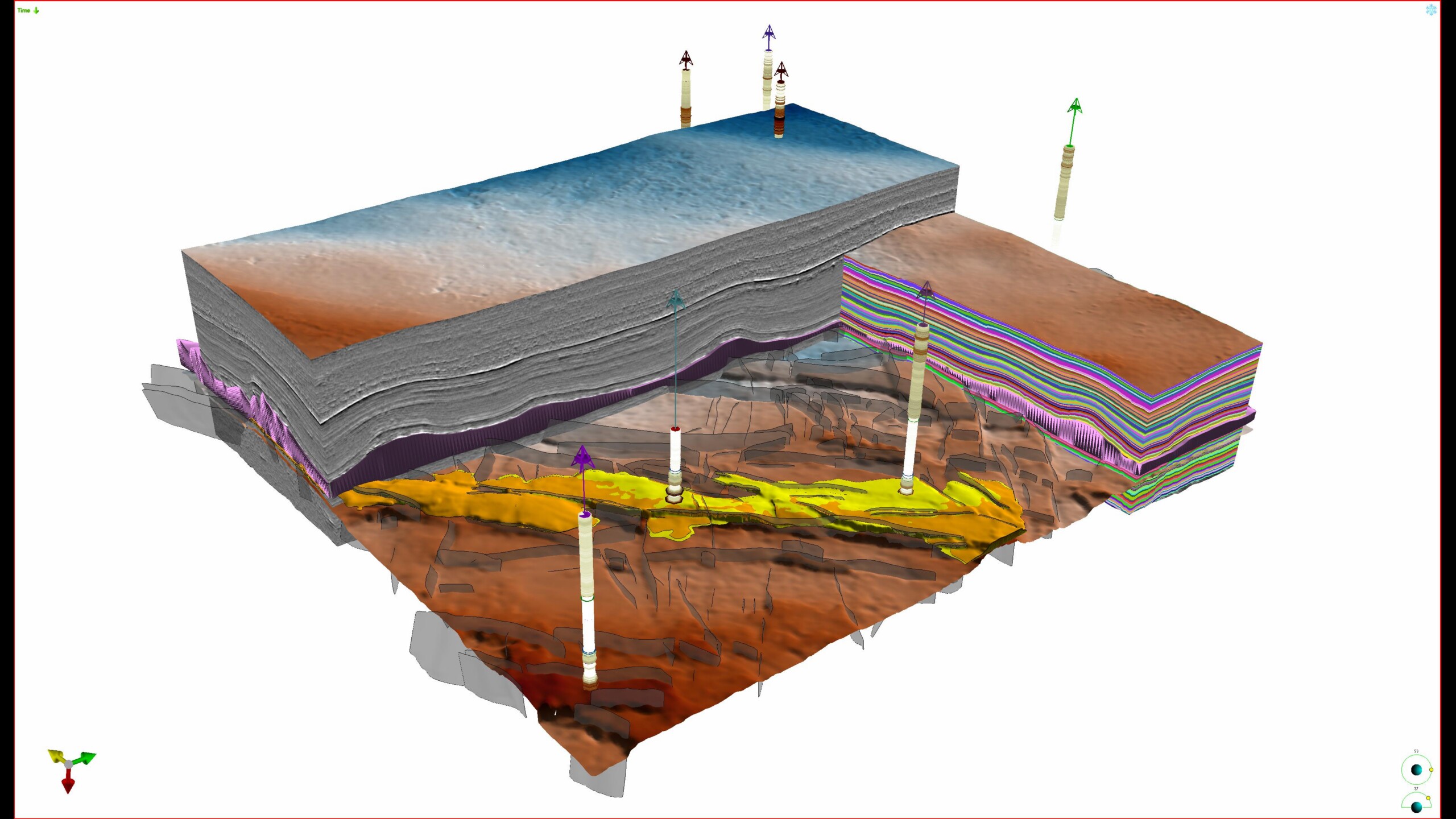 The release graphic is a PaleoScan 3D view, illustrating how far interpretation output has moved from 2D horizon picking toward full-volume visual products used for prospect evaluation and exploration decision-making.
Three reference numbers that put the deal in context
Bentley is a subscription machine that buys vertical depth rather than horizontal reach. In its fourth-quarter and full-year 2025 results the group reported total revenues of $1,501.8 million, up 11.0% year over year (10.1% in constant currency), with subscription revenues of $1,376.7 million, up 12.5%; fourth-quarter revenue alone was $391.6 million, up 11.9% (source: Bentley investor relations release, 26 February 2026, filed as an exhibit with the SEC). Three further benchmarks frame the Eliis transaction:
- Deal cadence: an industry tracker of Bentley's corporate-development history counts roughly 38 software acquisitions between 2015 and 2025, peaking at eleven deals in 2021 — the year Seequent itself came into the group (source: Aventis Advisors corporate-development review).
- Precedent scale: New Zealand business media reported the 2021 sale of Seequent to the Nasdaq-listed Bentley at US$1.05 billion, making it one of the country's billion-dollar technology exits (source: BusinessDesk).
- Reporting nuance: management has disclosed that a specific recurring-revenue business measure excludes ARR onboarded through major platform acquisitions including Seequent — so acquisitive growth is tracked separately from organic subscription growth, which is exactly the metric an analyst should request for Eliis (source: Bentley Q4 and FY2025 earnings call transcript).
What Relative Geological Time actually changes in a workflow
The technical reason this matters commercially is that Relative Geological Time (RGT) modelling turns interpretation into an automated, full-volume classification problem instead of a manual picking problem. Eliis documentation describes PaleoScan's ability to produce a 3D geological model of the entire seismic cube, and conference abstracts on RGT-based workflows argue that they reduce interpreter bias and minimise manual intervention (sources: eliis-geo.com product page; GeoConvention abstract archive). For a manager, the operational translation is straightforward: fewer person-hours per survey, a consistent stratigraphic frame across a basin, and an audit trail that survives staff turnover.
A defensible evaluation sequence for a team that already owns interpretation licences:
- Inventory one representative survey (2D, 3D or 4D) with known picks, so you have a ground truth to measure against.
- Build the RGT volume and let the platform classify horizons and faults across the cube rather than re-picking every line.
- Run the AI-assisted structural interpretation layer and compare outputs with the incumbent platform's fault model; note that Eliis has publicly described automated fault-detection work developed with a major operator, including an AI FaultAssist capability built with the Chevron Technical Center and a 2024 Chevron collaboration announced by the company (sources: eliis-geo.com partnership posts; offshore-energy.biz coverage of the second integration phase).
- Move the interpretation products into an implicit 3D modelling environment — the natural candidate inside the group is Leapfrog — and test whether the structural framework survives the transfer without manual repair.
- Publish the model into a shared data and review environment so non-technical stakeholders can see the same subsurface, a capability Seequent has long marketed for underground visibility in projects where late ground surprises are the expensive failure mode.
A 30 / 60 / 90 evaluation plan for software owners
Days 1–30: freeze the facts
Request, in writing, the post-close position on licence validity, support tiers, named-account ownership and price protection through the current term. Do not rely on marketing FAQs: counsel on both sides of deals of this shape routinely flag licence assignment and change-of-control wording as the most expensive oversight (source: Nixon Peabody analysis of software-licensing due diligence in M&A).
Days 31–60: test the seam
Run a paid or trial pilot on the exact handover point that matters — PaleoScan output into Leapfrog modelling, or interpretation deliverables destined for simulation via PaleoModel. Measure round-trip rework, format losses and the number of manual repairs per model. Compare against the cost of keeping a dual stack.
Days 61–90: decide and document
Choose one of three postures: consolidate onto the expanded Seequent stack, stay multi-vendor and buy interoperability, or defer through the next renewal. Whichever you pick, record the decision against named roadmap commitments, because acquisitions of this type are frequently re-priced at the second renewal rather than the first.
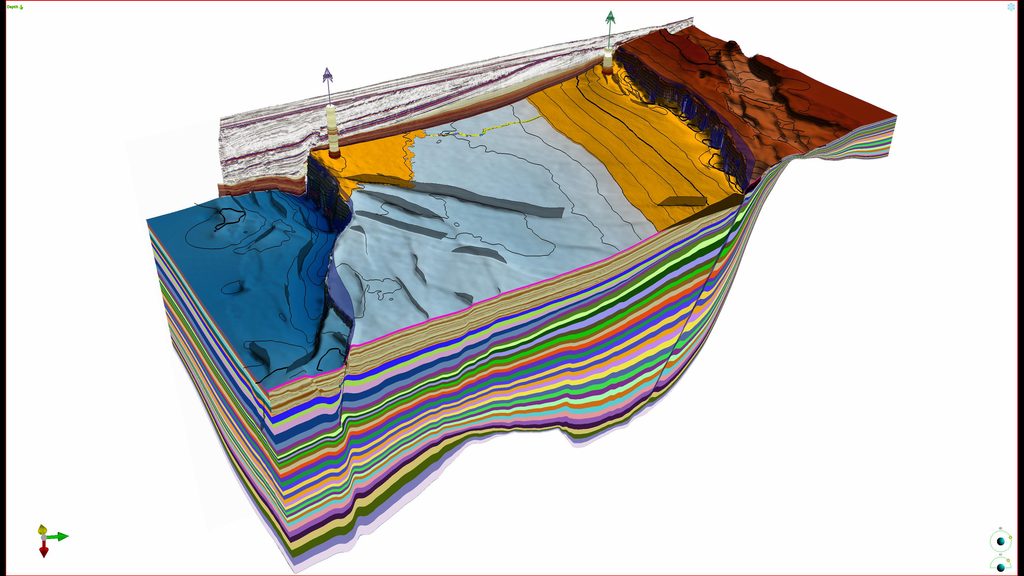 The second release figure shows 3D seismic interpretation inside PaleoScan using RGT to sharpen stratigraphic analysis — the workflow layer that Seequent's portfolio previously reached only after interpretation was finished elsewhere.
Buyer's due-diligence checklist
- Change-of-control and assignment clauses in the current Eliis master agreement; written confirmation that the term survives the close.
- Support continuity for the Montpellier engineering team: language coverage, time zones, escalation paths and named specialists.
- Roadmap governance: does PaleoScan stay a standalone SKU, or merge into a Seequent or Bentley subscription bundle?
- Export formats and data portability for seismic volumes, RGT models and fault sets — the single biggest lock-in lever.
- AI model provenance: which interpretation aids come from the Chevron collaboration, who owns the weights, and what happens to them if a customer's data is used in training.
- Seat economics: per-seat versus per-project pricing after bundling with Leapfrog and the wider geophysics line.
- Benchmark against the incumbents you already evaluate annually — platforms such as Petrel, Kingdom, DecisionSpace, OpendTect and GeoTeric are the practical comparison set cited in buyer round-ups.
- Procurement risk in regulated jurisdictions: EU-hosted development and data residency expectations from a France-based team now reporting to a US-listed parent.
- Key-person exposure: more than 100 specialists is a capability, but interpretation projects still concentrate in a handful of senior names.
- Terrain-risk spillover: whether seismic interpretation migrates into civil and environmental work, where tunnelling and ground-risk clients buy Seequent's modelling tools today.
Common pitfalls in deals like this one
- Reading capability overlap as product overlap. Implicit geological modelling and seismic interpretation are adjacent, not duplicate; assume neither tool absorbs the other quickly.
- Waiting for the vendor to tell you the roadmap. Post-close roadmaps are usually communicated late and in bundles; ask for written integration milestones.
- Underestimating re-training. RGT-first interpretation changes habits; budget enablement time, not just licence fees.
- Renewing early out of uncertainty. Early renewals surrender price leverage exactly when the acquirer is most eager to report retention.
- Ignoring the talent signal. If the absorbed team's senior researchers begin to leave inside two quarters, treat it as the leading indicator of product stagnation.
Competitive read: what the stack now covers
Before this transaction, the group's subsurface story ran from geophysical and geotechnical data capture to 3D geological modelling, with interpretation of seismic imaging largely outsourced to specialist platforms. Adding PaleoScan and PaleoModel pulls the front end of that pipeline in-house, and the more than 100-person team gives the acquired capability delivery weight rather than code alone. For investors, the sharper question is concentration: subsurface software buyers in energy, mining and civil infrastructure now face one fewer independent interpretation vendor at the top of the market, which tends to compress discounting room within two renewal cycles.
FAQ
Is a purchase price disclosed?
No. The published announcement frames the transaction around portfolio breadth, geophysics capability and specialist headcount. Historical context is available: the 2021 Seequent sale was reported at US$1.05 billion by New Zealand business media, but nothing equivalent has been published for Eliis.
Why is an interpretation tool valuable inside a modelling company?
Because interpretation is where the subsurface concept is born. High-resolution geophysical data acquired through seismic methods must be turned into horizons, faults and stratigraphic frameworks before any model or simulation is built. Controlling both ends shortens the loop from survey to decision.
What does PaleoModel add beyond PaleoScan?
PaleoModel is a co-innovation project directed at downstream reservoir simulation — the handover point where interpretation products become input for dynamic modelling rather than static maps.
Should a competitor's customer switch immediately?
No — and that would be the wrong lesson. The realistic move is to run a bounded pilot on the interpretation-to-model handover, secure written continuity terms, and then let retention and roadmap delivery decide over the following two quarters.
Does this affect non-energy sectors?
Indirectly. Seequent's portfolio spans civil, groundwater and geotechnical users, and group leadership has publicly argued that better underground visibility helps avoid costly project delays. Seismic interpretation depth sitting inside the same company raises the ceiling for future ground-risk workflows beyond hydrocarbons.
Action prompts for this week
- Pull your current Eliis and Seequent contracts into one file and flag every clause that references assignment, control change or successor obligations.
- Ask the vendor, in writing, three questions: support ownership, roadmap integration, and pricing treatment at the next renewal.
- Scope a two-survey pilot that measures interpretation-to-model round-trip rework against your baseline.
- Track the next Bentley earnings materials for any disclosure of acquired ARR onboarding — this is the cleanest proxy for whether Eliis is being monetised or merely retained.
- Brief your procurement lead on the consolidation angle: fewer independent interpretation vendors means less negotiating leverage in future competitive tenders.
The headline will not age well on its own, but the operating consequences will be visible for years: a 2007-founded French interpretation specialist now sits inside a Nasdaq-listed infrastructure-software group, its tools share a roadmap with Leapfrog, and its more than 100 people are the variable that decides whether this was a capability purchase or a talent purchase. Treat the announcement as the start of your own diligence cycle, not the end of the news item.