
Teammates vs Dots vs Claude Duet: A SaaS Buyer's Read on Perplexity's New AI Agent
Perplexity has moved from answering questions to owning unfinished work. Teammates, the agent it recently unveiled, plans, tracks and follows through on long-running projects, and it is pitched directly against OpenAI Dots and Anthropic's Claude Duet. For software buyers the verdict is narrow rather than absolute: it is the strongest option for small senior teams that value continuity across tools, and the weakest for broad rollouts, because access sits behind a single $200 per month tier instead of an admin-managed workspace plan.
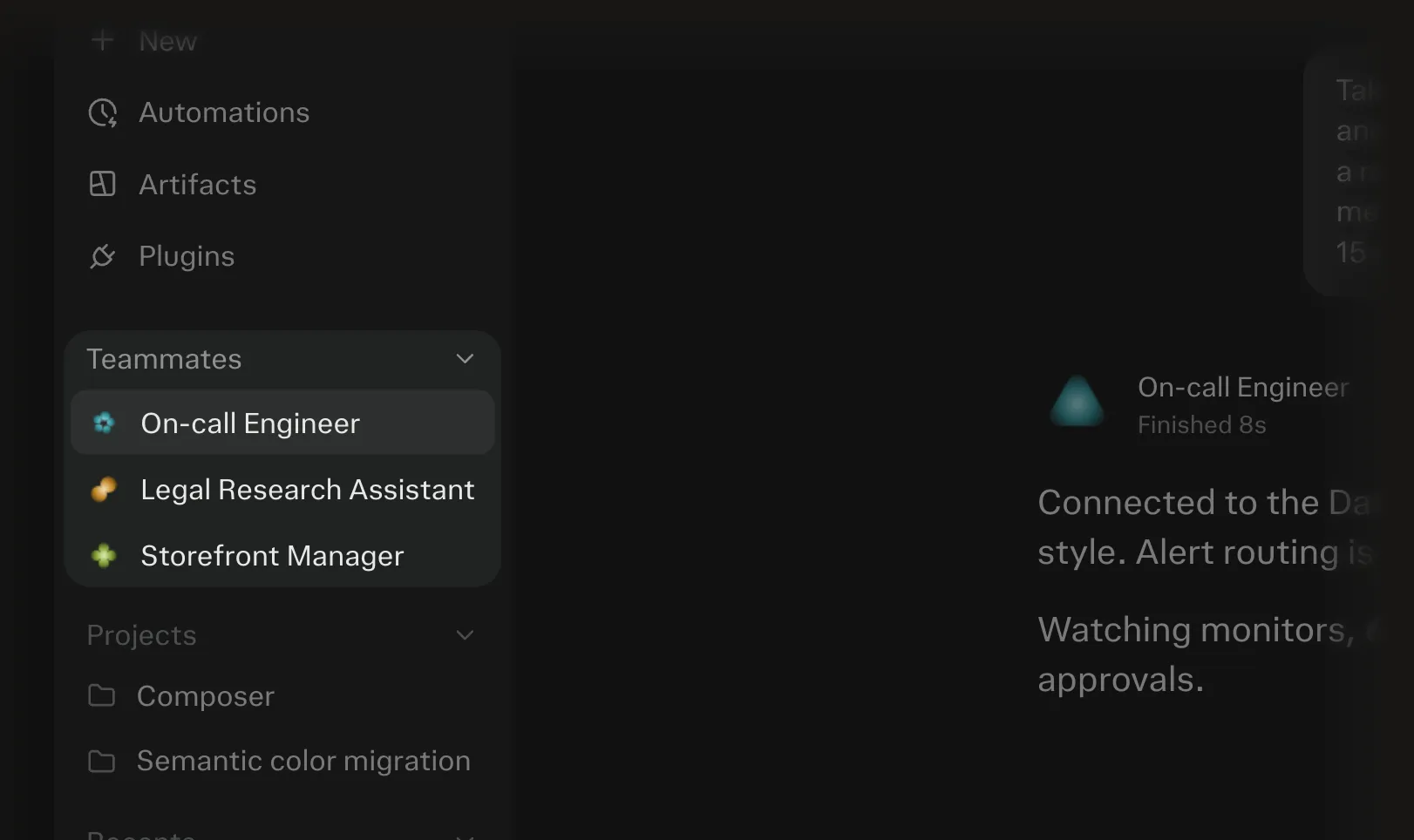
What exactly did Perplexity launch?
Short answer: a persistent coworker layer, not a faster chatbot. Teammates is an agent that keeps responsibility for a project between sessions, rather than returning one output and forgetting the context.
The product is built on Computer, Perplexity's system that deploys agents on a user's device to carry out concrete tasks. Teammates adds coordination on top of that base: one Teammate can orchestrate several Computer sessions and other agents, so work items run in parallel and hand off to each other as the project moves.
Three mechanics matter for evaluation:
- Standing threads. Every Teammate keeps its own persistent conversation thread, where you can inspect status, review completed work and redirect priorities at any point.
- Shared memory. Goals, execution history and shared files stay recorded, so follow-up tasks do not require re-explaining the brief each morning.
- Role assignment. Buyers can split duties the way they would split headcount — marketing, sales, customer support, operations or financial analysis — and let the agents cooperate on a common objective.
Perplexity's sales example is telling: an agent notices that a long-standing customer stopped ordering, reads the order history and support records, works out likely causes and drafts a recovery offer before pinging the human team. Chief Executive Aravind Srinivas frames the end state as hundreds of dedicated agents supporting each employee, absorbing coordination overhead rather than creative judgement. Availability is deliberately gated: Teammates opens on the web for Perplexity Max subscribers, with iOS and wider access promised in the coming weeks (as relayed by Sina Finance, citing Perplexity's announcement).
How do Teammates, Dots and Claude Duet differ?
All three sell autonomy, but they sit in different parts of the buying stack. The table below isolates the five dimensions that actually change a procurement decision.
| Dimension | Perplexity Teammates | OpenAI Dots | Anthropic Claude Duet |
|---|---|---|---|
| Core promise | Owns ongoing projects and coordinates multiple agents | Always-on personal agents inside ChatGPT | Proactive assistant that surfaces what needs attention |
| Where work executes | On-device agents inherited from Computer | Tied to the ChatGPT workspace surface | Runs in its own cloud environment so work continues after you disconnect |
| Human checkpoint | Review inside the app thread or in Slack | Admin enablement gates beta access | Waitlist-gated research preview |
| Entry price | $200 per month via Perplexity Max | First dot bundled into ChatGPT Pro plans | Bundled into existing Pro and Max plans, no Team or Enterprise access yet |
| Buying path | Individual subscription, self-serve | Enterprise, Edu and Healthcare roll out when a workspace admin turns it on | US Pro and Max users only, queue by waitlist |
Sources for the comparison rows: OpenAI's own Dots announcement page, Anthropic's Claude Duet product page, and Perplexity's launch coverage.
Where the trade-offs bite
The interesting divergence is governance, not capability.
- Advantage — team-native control plane. Slack integration means staff can assign work, query progress and receive handoffs without opening another console, and agents can pass findings between themselves: one discovers a defect, another drafts the remediation plan. For distributed product teams, this removes the biggest adoption friction, which is context-switching.
- Advantage — continuity as the unit of value. Dots and Claude Duet optimise for an assistant that is always reachable; Teammates optimises for work that is never abandoned. If your bottleneck is multi-week follow-through, continuity is worth more than availability.
- Trade-off — individual subscription, no admin layer. A self-serve, premium tier path is the opposite of OpenAI's admin-enabled beta and Anthropic's enterprise-excluded preview. It buys speed, but the buyer loses centralised provisioning, seat revocation and org-wide policy control — the classic shadow-IT pattern.
- Trade-off — device-resident execution. Building on Computer means agents act on the user's own machine and toolset, which is powerful for bespoke workflows and awkward for regulated estates where endpoint actions must be logged and contained. Anthropic's separate cloud environment is the safer default in that setting.
What the $200 per month signal says about agent economics
Pricing is the most under-discussed part of this launch. A flat premium tier for an agent that runs around the clock behaves like a salary line, not a software line.
The contrast is worth noting: in adjacent support software, vendors have begun charging for results rather than access — Zendesk, for instance, prices its AI tier per automated resolution at roughly $1.50 to $2.00. Perplexity is doing the reverse, selling capacity and continuity on a fixed monthly plan.
On our analysis at GlobalSaaSManager, that structure rewards a specific buyer profile. A ten-person pilot on Max subscriptions is about $24,000 per year before tax and cancellation clauses. The tier breaks even only if each agent removes recurring coordination time — chasing statuses, re-briefing tools, reconciling files — rather than merely speeding up drafting. If the pilot instead displaces a vendor's outcome-priced workload, the fixed plan can become the more expensive choice within two quarters. Negotiate nothing yet, but model both curves before you commit a seat count.
Which organisations should pilot now, and which should wait
Pilot Teammates if
- you run a senior team of fewer than 15 people where one operator owns a pipeline end to end;
- your workflow is cross-tool by nature — CRM, ticket history, order data, shared docs;
- Slack is already your system of record for status; and
- you can absorb preview-stage behaviour changes without a board-level commitment.
Wait if
- you need centralised identity, seat revocation or role separation before deployment;
- endpoint-resident actions collide with your device-management policy;
- your procurement cycle requires a written security review and retention terms; or
- the business case only works per resolved task, not per subscribed person.
What market data says about the downside
Adoption headlines outrun deployment reality. Gartner's 2026 Hype Cycle for Agentic AI reports that only 17% of organisations had deployed AI agents at the time of research, while more than 60% expect to do so within two years — the steepest adoption curve in the study. The same firm predicts over 40% of agentic AI projects will be cancelled by the end of 2027, and that 15% of day-to-day work decisions will be made autonomously by 2028, up from effectively 0% in 2024.
Read commercially, the risk in this category is not weak technology; it is unowned workflows that never survive the pilot budget line. Vendors who pick a project with a measurable baseline and a named human reviewer are the ones that survive that cull.
Action plan: your first 30 days
- Pick one multi-week workflow with a visible baseline — churn recovery, ticket triage or competitive monitoring — and write down today's cycle time.
- Run a two-seat trial, not a department rollout. Buy two Max subscriptions, evaluate for one billing cycle, and treat it as instrumented research.
- Define the approval boundary. List which actions an agent may take unilaterally and which require a human nod; record it before onboarding, since Teammates threads give you an audit trail if you use them deliberately.
- Test the Slack handoff. Verify that agent-to-agent escalation and channel visibility meet your internal reporting standards.
- Score against a rival. Run the same brief through OpenAI Dots or Claude Duet and compare cost per completed outcome, not demo polish.
- Set a kill criterion. If the workflow's cycle time is not down materially within 30 days, stop before it becomes a portfolio of abandoned pilots.
FAQ: what buyers are asking
Is Teammates an enterprise product?
Functionally it targets enterprise work; commercially it is sold as a premium subscription tier today, so it lacks the admin, provisioning and policy surface that a formal enterprise contract normally provides.
Does it replace OpenAI Dots or Claude Duet?
No. Teammates differentiates on multi-agent coordination and long-lived project memory, Dots on workspace ubiquity, and Claude Duet on proactive monitoring of connected accounts from an environment that keeps running after the user disconnects.
Why does the Slack integration matter so much?
Because the cost of an agent is rarely the model call — it is the supervision. A shared channel makes delegation, status checks and handoffs visible to the rest of the team, which is what converts a demo into a routine.
How should the price be judged?
Convert $200 per month into a unit of work: hours of coordination removed, follow-ups completed and cycle time saved. If you cannot name that number, the subscription is a lifestyle cost, not a productivity investment.
Sources cited
- OpenAI, "Introducing dots" — https://openai.com/index/introducing-dots/
- Anthropic, "Claude Duet" product page — https://claude.com/product/claude-duet
- Gartner, "2026 Hype Cycle for Agentic AI" — https://www.gartner.com/en/articles/hype-cycle-for-agentic-ai
- Gartner press release on agentic AI project cancellations — https://www.gartner.com/en/newsroom/press-releases/2025-06-25-gartner-predicts-over-40-percent-of-agentic-ai-projects-will-be-canceled-by-end-of-2027
- Sina Finance on Perplexity's Teammates launch and rollout plan — https://finance.sina.com.cn/tech/digi/2026-11-06/doc-inixuqia5501178.shtml
- The SaaS CFO on outcome-based pricing (Zendesk per-resolution rates) — https://www.thesaascfo.com/saas-per-seat-pricing/
Analysis by Kai Brooks, GlobalSaaSManager — SaaSIndustryNews. Independent evaluation; subscription terms and preview access change quickly, so re-check vendor pages before procurement.