
GPT 6.2 Astra and a 47% Benchmark Jump: A GlobalSaaSManager Q&A for SaaS Decision-Makers
Rumors outran the roadmap this week. In recent days, developers auditing their Codex usage analytics found a model identifier OpenAI has never announced — gpt-6.2-astra — while the lab separately published engineering benchmark scores hinting at a step-change in capability. Neither thread is confirmed, and the ambiguity is the story: for founders, product leads, investors and enterprise software buyers, the useful response is not to chase a release date but to test whether the stack can absorb a model change nobody authorised. The questions and answers below turn the leak evidence, the BenchCAD 2.0 numbers and OpenAI's physical-engineering disclosures into moves you can make this quarter.
The 60-second brief
- Signal in the data: TestingCatalog reported that from October 31 some Codex accounts showed GPT 6.2 Astra as a standalone line in usage analytics, even though the model picker still displayed GPT 6 Astra.
- Traffic split: on the X platform, blogger Token Gremlin shared a screenshot in which about 19.8% of model calls were attributed to GPT 6.2 Astra and roughly 80% to GPT 6 Astra; other accounts show different ratios.
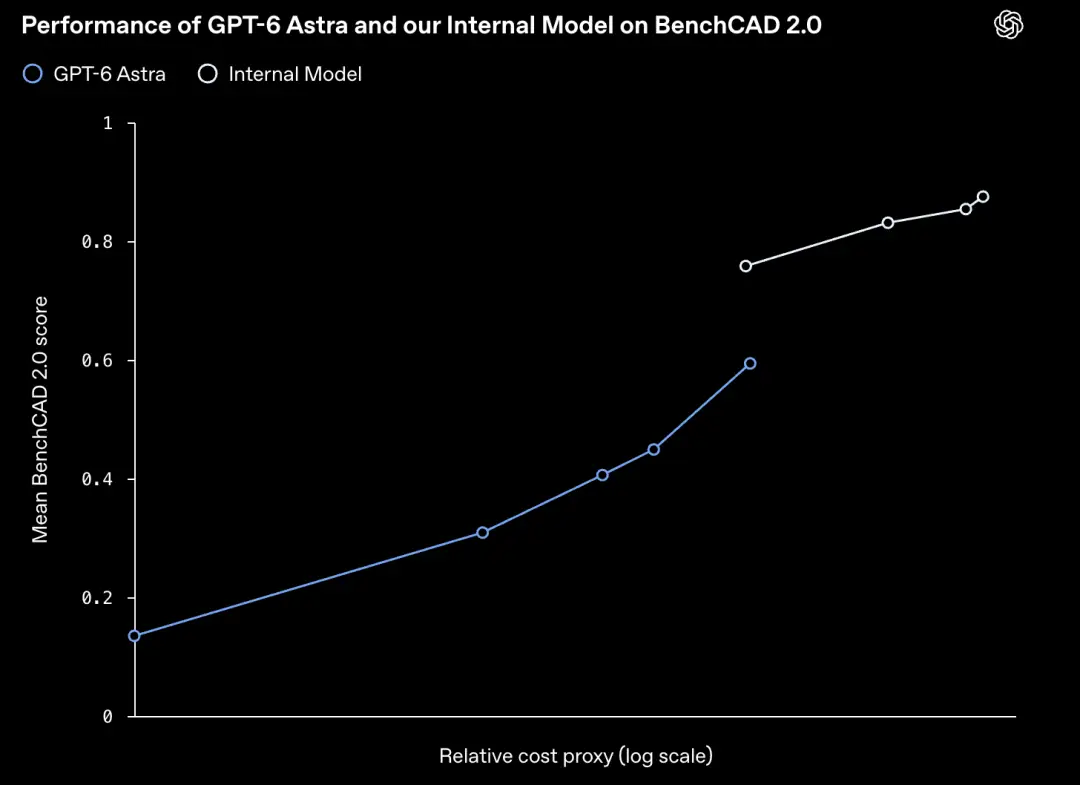
- Benchmark: on BenchCAD 2.0, GPT 6 Astra averaged 0.594 at the highest reasoning setting, while a newer internal model reached 0.875 — a lift of about 47.3%.
- Official status: OpenAI has not announced GPT 6.2 Astra, has not confirmed gray testing or a timeline, and has not named the internal model behind those scores.
Five questions that actually matter for your roadmap
Q1. What exactly was found inside Codex?
A naming mismatch. According to the TestingCatalog report, usage-analytics pages began logging gpt-6.2-astra as a separate record from October 31, while the screen where a user selects a model continued to show GPT 6 Astra. That mismatch is the commercially interesting detail: work can be routed to a different engine without any visible action by the customer, which breaks the assumption that interface labels describe what actually served a request.
Q2. Is the 19.8% figure proof of a launch?
Treat it as evidence of experimentation, not availability. The ~19.8% versus ~80% split posted by Token Gremlin on the X platform, combined with the differing ratios reported by other users, fits an A/B test or backend request-routing arrangement: a slice of traffic is forwarded to a candidate model while the product surface keeps its existing name. The practical consequence is that a gray test can be widened, narrowed or cancelled at will, so any forecast, contract clause or roadmap milestone anchored to a fixed general-availability date is resting on sand.
Q3. What about the two identifiers that appeared and vanished?
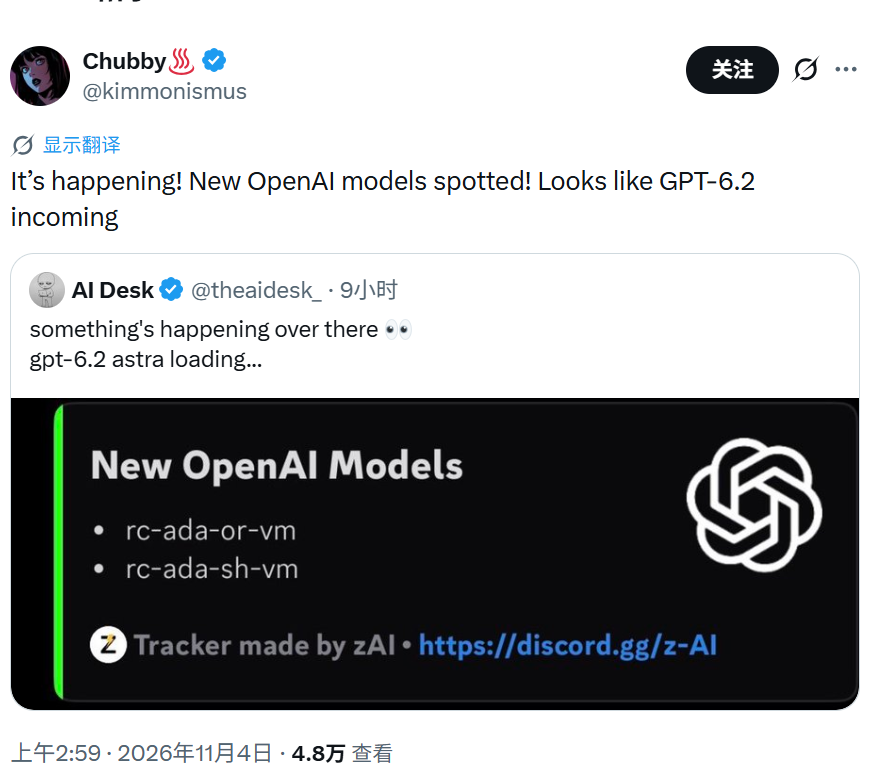
On November 3, model-tracking account LuminaBench said the OpenAI API model list briefly showed two new entries, rc-ada-or-vm and rc-ada-sh-vm, before they disappeared. Some developers read the rc- prefix as a release-candidate tag, but no evidence confirms they correspond to GPT 6.2 Astra. Transient strings like these are signal only if you can reproduce them in your own tenant: log them, screenshot them, but do not plan delivery dates around them.
Q4. Should we believe a 47% engineering jump?
The scores are real; the interpretation is narrow. In the figures OpenAI published, the newer internal model averaged 0.875 against GPT 6 Astra's 0.594 on BenchCAD 2.0, a relative improvement of roughly 47.3%. That benchmark evaluates whether a model can rebuild three-dimensional mechanical parts and assemblies and identify circuit-board connection relationships. Two pieces of context change how much weight the number can carry. The benchmark's own public reporting describes results scored on a 0-to-1 scale across six task families using held-out cases executed at maximum reasoning effort, which is also the most expensive configuration to run in production; and OpenAI itself notes that benchmark results cannot directly represent overall success rates on real manufacturing tasks. Read 47% as headroom in a controlled test, not as hours saved on the shop floor.
Q5. Has OpenAI confirmed anything?
Not the model. OpenAI has neither formally published GPT 6.2 Astra nor acknowledged the gray testing or a release window, and demonstration videos circulating on social platforms remain disputed, so they cannot count as verified performance evidence. What the company did publish is a direction of travel: its November 3 research post on accelerating engineering for the physical world describes progress across mechanical design, electronics and end-to-end system design, referring to the stronger engine only as a newer internal model.
What is already on the record: hardware, prototypes and token growth
Setting the rumor thread aside, OpenAI documented concrete work already being done with GPT 6 Astra:
- Design sprint: two engineers used GPT 6 Astra to complete the design of a portable AI device in less than a week, with the model contributing to enclosure structure, internal mechanical components, the PCB, electronic components, the user interface and firmware software.
- No manual hand-editing: during the design phase the engineers did not directly modify the model-generated design by hand.
- Prototype turnaround: a contract factory then produced a small batch of physical prototypes in less than a month.
- Remaining limits: OpenAI concedes that converting a design into a manufacturable product still requires multiple rounds of human review and iteration, and that GPT 6 Astra cannot consistently account for production process constraints, manufacturing tolerances and assembly details.
- Consumption curve: since February this year, OpenAI's hardware team has increased the tokens consumed by AI models 23x, with Codex and ChatGPT applied to computer-aided design, manufacturing drawing generation, engineering simulation and design review.
The last bullet is the one finance teams should copy into their models. A 23x internal growth curve is a demand signal, and Codex access now moves beyond flat seat fees toward token-credit metering, so an upgrade treated purely as a capability story can arrive as an invoice surprise. Re-forecast spend on your heaviest reasoning workflows, not on your average prompt, and set alerts on per-request token deltas before a new flagship is enabled.
Partnerships read as market signals
On the collaboration front, OpenAI announced a new research partnership with Mazda to explore AI-assisted automotive aerodynamics and crash-safety design, where GPT 6 Astra generates different front-end geometry options and airflow simulation helps engineers evaluate them. Mazda chief engineer Akihiko Nakata said that using AI to explore and simulate dozens of design variants lets engineers understand more clearly which shape features influence aerodynamic performance, and where designers hold greater freedom. OpenAI also expanded its collaboration with IndyCar team Chip Ganassi Racing, converting three-dimensional scan data of existing components into editable CAD models and two-dimensional manufacturing drawings to reduce repetitive reverse-modelling and prototype work.
For software vendors the read-through is uncomfortable. The workflow layer OpenAI describes — parametric models, drawings, simulation setup, design review — is precisely the layer established platforms monetise, and incumbent suites such as Autodesk Fusion, PTC Creo, Siemens NX and Dassault SOLIDWORKS already ship generative and assistive AI capabilities. A frontier-model upgrade cycle therefore compresses the differentiation window for PLM and engineering-design SaaS providers and increases bundling pressure on point tools. Enterprise buyers gain leverage in the same move: ask suppliers to quantify AI gains against a public benchmark and a customer-run test, not against a vendor demo.
Decision table: adopt, pilot or wait
| Reader scenario | What this week changes | Recommended move | Trigger to watch |
|---|---|---|---|
| Product team shipping coding agents | A candidate engine is already handling a share of live Codex traffic without an interface change | Build a golden-set regression gate and per-model logging now, before any vendor switches traffic at scale | An official GPT 6.2 Astra model card with named pricing and rate limits |
| Hardware or mechanical design lead | BenchCAD 2.0 headroom plus a documented device design in less than a week | Pilot on one non-critical bracket, housing or fixture set; keep tolerance review human | Independently reproduced benchmark results on your own part library |
| Enterprise software procurement | Silent backend routing is now visible in usage analytics | Add model-change notice, version pinning and audit-log clauses at renewal | Vendor refusal to commit to change notification terms |
| Investor or industry analyst | 23x token growth inside OpenAI's hardware team, plus OEM partnerships | Treat engineering-workload AI as an infrastructure-cost thesis, not a chatbot upgrade cycle | Whether auto manufacturers convert research collaborations into paid deployments |
Checklist: six controls to install before the next flagship lands
- Pin what you run. Request explicit model versions rather than rolling aliases in production calls, and keep one tested legacy mapping available for immediate rollback.
- Log the served identifier. Store the model string returned with every request so you can later prove which engine produced which output.
- Gate quality with a golden set. Re-run a fixed dataset of real prompts on every change; a benchmark lift of about 47.3% in one domain says nothing about your prompts.
- Bound reasoning cost. Cap reasoning effort per workflow and alert on token consumption deltas, since gains published at maximum reasoning settings carry the steepest price.
- Keep a disclosure trail. EU AI Act transparency rules oblige general-purpose AI providers to supply downstream deployers with technical documentation and require users in defined situations to be informed when AI is involved, so unannounced model swaps complicate your compliance record.
- Mark unverified claims. Until OpenAI confirms GPT 6.2 Astra, leaked identifiers and social-media demos should be labelled unverified in any board or client material.
FAQ: fast answers for a moving story
Is GPT 6.2 Astra available to buy today?
No. Only usage-analytics records and a benchmark table exist; OpenAI has not announced the model or a release date.
Why does the interface still show GPT 6 Astra?
Because gray or A/B testing routes a share of requests in the background while the visible name stays unchanged, which is exactly what the ~19.8% and ~80% split suggests.
Does the ~47.3% benchmark gain mean my engineers will finish faster?
Not automatically. It measures modelled CAD reconstruction and board-connection tasks at maximum reasoning effort; your cycle-time gain depends on part complexity and how much human tolerance review remains.
Is the newer internal model the same thing as GPT 6.2 Astra?
Unconfirmed. OpenAI did not disclose the internal model's formal name or state whether it corresponds to the rumored version.
Should we pause our AI software contract until launch?
Usually no. Sign, but insist on model-change notification, version pinning, audit logging and a benchmark-based acceptance test you can re-run later.
What is the next thing worth watching?
A first-party statement: an official model announcement, a published model card, or a persistent — rather than brief — entry in the OpenAI API model list.
Action prompts: the call for this week
Two facts can be acted on now and neither requires a launch: OpenAI's usage records show that traffic assignment can change underneath a familiar label, and its own hardware team's 23x token curve shows how fast consumption escalates once models enter CAD, simulation and design review. So run three motions before the calendar turns: verify that your gateway records which model answered each call; score your own workflow on one mechanical or electrical task rather than trusting a headline percentage; and put change-notification language in front of your vendors at renewal. If OpenAI confirms GPT 6.2 Astra next month, teams with those controls upgrade on evidence; teams without them discover the change through a support ticket. GlobalSaaSManager will update this Q&A the moment the company speaks — readers tracking the story for a procurement decision can write to info@globalsaasmanager.com.