
Global SaaS Industry News Q&A: Google Now Charges U.S. Schools AI Access for Their Search — Who Switches, Who Pays, What To Do Next
Direct answer: from early 2027, a U.S. K-12 district that turns off every Google AI tool also loses Google Search on school-managed student accounts, because Search and Gemini-class features sit behind one administrative opt-in. DuckDuckGo is exploiting the gap, pitching schools a classic results page whose AI layers can be toggled without losing search itself.
The move reframes a procurement question that software buyers usually delegate to IT: whether a “free” productivity stack can be exited selectively. Below, GlobalSaaSManager answers the questions founders, investors, product leads and district purchasers are asking this week — in short answers, with the numbers that matter.
Fast read: summary, impact, action
- The change. Google announced the new K-12 administration policy on 3 November 2026; rollout begins early 2027. Gemini, Gemini Notebook, Gemini inside Classroom and Google Search on school-managed student accounts are off by default, and administrators re-enable them tool by tool.
- The catch. Opt out of AI completely and Search goes away too. Google’s education chief argues search and AI are now too entangled to separate.
- The challenger. DuckDuckGo is offering schools hands-on migration help and a default-engine playbook, framing mandatory AI as abuse of market power.
- The stake. Google-reported figures put more than 170 million students and educators on its education stack, and StatCounter still measured Google near 91% of global search through 2026, versus DuckDuckGo under 1% globally and roughly 1.75% in the United States.
- The action. Inventory the AI toggle dependencies, decide search defaults before the rollout window, and rewrite contract language on AI disclosure, logging and notice periods.
What exactly did Google change, and when does it bite?
Conclusion first: the policy is a bundling decision, not an AI ban. School admins gain item-level control — they may disable Gemini and Gemini Notebook while keeping Search enabled — but the bundle has one-way semantics: refusing AI altogether also removes search access for those accounts.
Google’s stated reason is technical: search and artificial-intelligence capability have fused so deeply that a version of Search fully stripped of AI cannot be offered. Chris Phillips, Google’s vice-president and general manager of education, told The New York Times that students in schools prohibiting AI entirely will not be able to reach Google Search through school accounts, and will instead see a message that the service is unavailable.
Two timing points make this more than a press-release story. First, the default-off posture reverses Google’s own course from the summer: its Workspace Updates bulletin of 4 August 2026 opened the Gemini tab in Classroom to K-12 students of all ages from 10 August 2026, provided admins had granted permission. Second, the switch lands mid-budget-cycle, so districts that want a search fallback must procure it before early 2027 rather than after students hit a blank results page.
Why are teachers, parents and a U.S. senator pushing back?
The objection is pedagogical before it is commercial. Many teachers and school administrators want classic link-list search to survive in lessons, so students can locate, compare and cite sources rather than consume an AI answer. Critics warn that leaning on generated summaries erodes independent research and critical-thinking habits.
Politicians joined in. In a statement reported by CT Insider, Senator Richard Blumenthal accused Google of “once again prioritizing profits over people — this time blocking schools from using Google search unless they opt into their AI” features, echoing the antitrust framing DuckDuckGo has used for years in its campaign over search remedies.
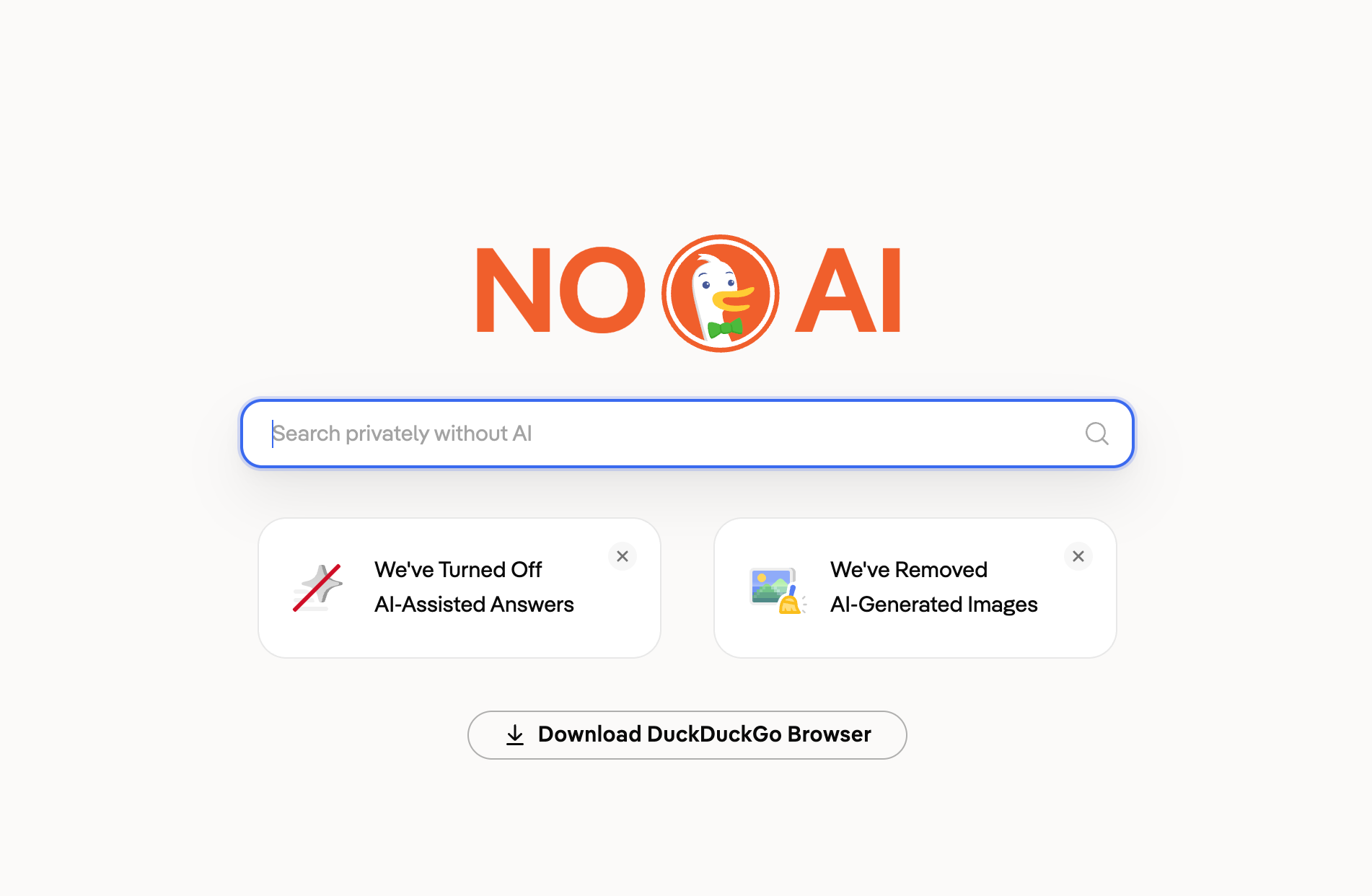
DuckDuckGo’s chief public affairs officer Kamyl Bazbaz put the sharper version: forcing AI on students is a textbook exercise of market dominance, and schools should prove through concrete choices that they still have one. Founder and chief executive Gabriel Weinberg went the operational route, publishing guidance for setting DuckDuckGo as a default search engine and offering migration and deployment assistance to institutions.
Is Google’s counter-offer enough — Guided Learning and default-off?
Not for every school. Google previously shipped Guided Learning, a mode that walks students through reasoning step by step instead of handing over an answer, precisely to defuse the “AI does the homework” criticism. After the backlash, Google said the new policy is meant to widen school control rather than shrink choice: Gemini, Gemini Notebook and the related AI capabilities will default to closed, with schools switching them on selectively.
The unresolved case is narrow but symbolically loaded: a district that wants Search with zero AI content cannot have it inside Google’s stack. DuckDuckGo says Google could ship such a version and simply chooses not to, and that students need neither AI summaries, chatbots nor generated text to do ordinary retrieval and academic work. Its school pitch rests on three guarantees: no forced AI-generated summaries, no mandatory chat interface, and AI features that can be switched either way without losing search itself.
Which option fits which buyer — a four-way comparison
| Option | AI exposure for students | Switching effort | Where it fits best | Main risk |
|---|---|---|---|---|
| Keep the Google stack, opt tools in selectively | Low to medium, controlled per tool | None — configuration only | Districts already standardised on Classroom, Docs and managed Chromebooks | Search results still carry AI layers that cannot be fully removed |
| Opt out of all AI inside Google | None | None, but loses Search | Schools with a separate, approved search tool already in place | Students see an “unavailable” message instead of results |
| Set DuckDuckGo as district default search | User- and admin-toggleable | Medium: policy push to devices, staff training, single sign-on and filter review | Privacy-first districts and AI-free learning environments | Far smaller query share (roughly 1.75% U.S.) means thinner integrations and less index coverage for niche academic content |
| Hybrid: DuckDuckGo default, Google Search for supervised tasks | Compartmentalised | Medium-high: needs clear rules per grade and assignment type | Secondary schools teaching source evaluation | Policy drift; teachers route around the rules under time pressure |
What does this mean for SaaS buyers, founders and investors?
For procurement teams, the episode converts an invisible variable — result quality and default routing — into a governance item. Three clauses deserve immediate attention in any software agreement for education or regulated users: whether AI features can be disabled without degrading a core function, how much notice a vendor must give before changing defaults, and what audit logs prove which mode a user account was in.
For founders and investors, the read-across is that distribution, not model quality, is the contested asset. Google’s structural advantage is device-level: Chromebooks and its education suite occupy the classroom by default, and Google-reported figures of more than 170 million students and educators on its education products make that position hard to challenge feature by feature. Challenger engines compete on choice, not scale — a strategy with measurable but modest traction: TechCrunch reported in May 2026 that DuckDuckGo saw U.S. installs climb about 30% after Google’s I/O overhaul pushed AI to the top of results, a spike that shows willingness to switch, not durable share gain, given a still sub-2% U.S. search position.
Market implication for global operators: default-off plus per-tool opt-in is likely to become the regulatory-safe configuration template beyond education, including consumer productivity suites sold in the European Union and other jurisdictions where consent and child-safety duties are tightening. Treat AI modes as separately licensable, separately disableable SKUs, and price accordingly.
Action checklist before the early-2027 rollout
- Map dependencies: list every workflow that calls Google Search from student accounts, from research projects to exam tools, and flag which must remain AI-free by policy.
- Decide the search default in writing — Google-opt-in, replacement engine, or hybrid — before the device refresh cycle closes.
- Pilot the admin console settings for Gemini, Gemini Notebook and search on a small cohort, and verify what students actually see when access is denied.
- Pressure-test the alternative on real homework: run a sample research unit against both engines and score coverage, citation quality and loading behaviour on school hardware.
- Notify parents and teachers early; opt-out narratives travel fast, and the political risk sits with the district, not the vendor.
- Insert AI-disable-without-loss-of-function and notice-period commitments into renewals, and require logs that evidence the default state.
Frequently asked questions
Will every school-managed student account lose Google Search?
No. Loss is conditional on a district choosing to disable the AI layer completely. Where admins opt Search back in, students keep it — with the AI capabilities Google bundles into it. Reporting from CBS News confirms each of Gemini, Gemini Notebook and search can be turned on individually, all starting from a default of off.
When does the policy take effect?
Google announced it on 3 November 2026 and has tied the change to early 2027, which leaves roughly one academic year of configuration time for U.S. districts.
Can DuckDuckGo really replace Google Search for a whole district?
As a results layer, yes; as a platform, no. DuckDuckGo removes the forced-AI constraint and offers migration support, but Docs, Classroom and managed-device workflows stay on Google’s side, and its small query share means fewer third-party integrations built against it. Realistically it is a search-layer swap, not a suite migration.
Is this mainly an American problem?
The dispute is playing out in U.S. schools, but the pattern — bundling an AI feature set into a mandatory path through a default tool — is global. Buyers outside the United States face the same dependency in consumer and enterprise editions, and regulators elsewhere have an interest in whether a core function can be refused AI without being switched off.
What should a CEO or product lead copy from this?
Ship a switch that survives scrutiny: per-feature opt-in, default-off for minors, and a guarantee that disabling AI never revokes the base service. That is now the minimum bar for selling AI-adjacent features into education and other consent-sensitive markets.
Analysis note
The comparison table, checklist and buyer-clause recommendations in this article are GlobalSaaSManager’s own analysis built on the facts above; the underlying figures and statements come from the sources listed next.
Reference sources
- The New York Times, “Google Will Turn Off Search for Schools That Reject A.I.” — https://www.nytimes.com/2026/11/03/us/google-search-schools-restrict-ai.html
- CBS News, “Google will block search access for schools that ban AI use” — https://www.cbsnews.com/news/google-search-access-schools-ai-tools/
- TechCrunch, “Google will let schools disable its AI tools, but not without sacrificing search” — https://techcrunch.com/2026/11/03/google-will-let-schools-disable-its-ai-tools-but-not-without-sacrificing-search/
- TechCrunch, “DuckDuckGo installs are up 30% as users reject being ‘force-fed’ Google’s AI Search” — https://techcrunch.com/2026/05/26/duckduckgo-installs-are-up-30-as-users-reject-being-force-fed-googles-ai-search/
- Google Workspace Updates blog, Gemini in Google Classroom expansion to K-12 students, 4 August 2026 — https://workspaceupdates.googleblog.com/2026/08/gemini-in-google-classroom-is-expanding-to-users-of-all-ages-with-contextualized-Gemini-starter-prompts-for-students.html
- Google Admin help, “Manage access to Gemini in Classroom” — https://knowledge.workspace.google.com/admin/getting-started/editions/manage-access-to-gemini-in-classroom
- CT Insider, Blumenthal statement on Google’s school AI/search policy — https://www.ctinsider.com/news/education/article/google-ai-search-schools-blumenthal-22509508.php
- StatCounter Global Stats, search engine market share — https://gs.statcounter.com/search-engine-market-share