
Gemini Omni 1.2 Flash Case Retrospective: 15-Second Video at $0.07 Per Second and the Workflow Lessons for SaaS Teams
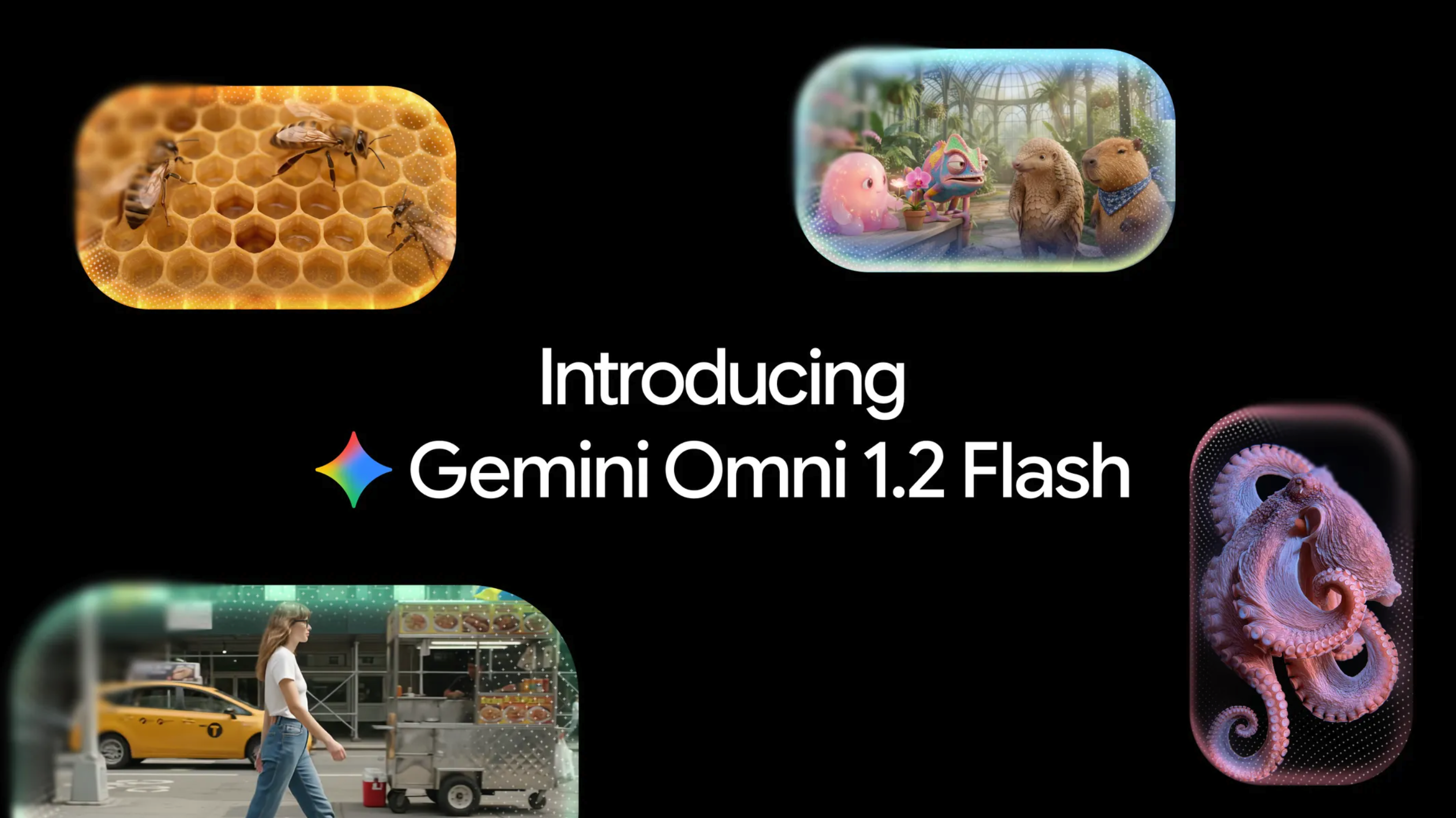
On Thursday, November 6, Google released Gemini Omni 1.2 Flash, a video generation model that natively produces clips of 3 to 15 seconds, lets teams revise footage through multi-turn Conversational Editing, and cuts 720p output pricing by 30% to $0.07 per second. For software buyers, product leads and growth owners, the real story is not the benchmark chart — it is a new cost baseline for creative iteration.
What actually changed on November 6?
Conclusion first: every headline delta points in the same direction — cheaper revisions, not merely cheaper renders. Clip ceiling, pricing, editing method and reference handling moved together, which makes this a planning event for production teams rather than a spectator upgrade.
| Dimension | Previous generation | Gemini Omni 1.2 Flash | Why a manager should care |
|---|---|---|---|
| Native clip length | 10 seconds max | 3 to 15 seconds | A 15-second beat fits a full product story arc: hook, demo, payoff. |
| 720p price | ~$0.10 per second (GlobalSaaSManager calculation) | $0.07 per second, down 30% | Variant testing stops being rationed; you can afford to be wrong twice. |
| Revision model | Regenerate the clip | Conversational Editing across the full 15 seconds | Feedback loops collapse from “re-brief” to “say what to change”. |
| Reference inputs | Largely text and image prompts | Person image, product photo, video clip up to 3 seconds, audio cues | Brand systems, packaging type and colourways carry across shots. |
| Provenance | — | Invisible SynthID watermark on every generated video | Compliance evidence ships by default; you still have to protect it in transit. |
| Rollout surfaces | — | Gemini API, Google AI Studio, Google Cloud Console, Flow, Google Vids, the Gemini app for Google AI Ultra subscribers, and Google Ads, in stages | Buyers can pilot in a workspace tool before touching engineering time. |
Google framed the pricing move plainly in its launch post: “We have dropped the price 30% from Gemini Omni 1.1 making it available at $0.07 per second for 720p video.” Working backwards from that statement, the predecessor rate sat near $0.10 per second — a GlobalSaaSManager derivation, not a figure Google has published.
Case 1: How Google's own try-on demo translates into a production run
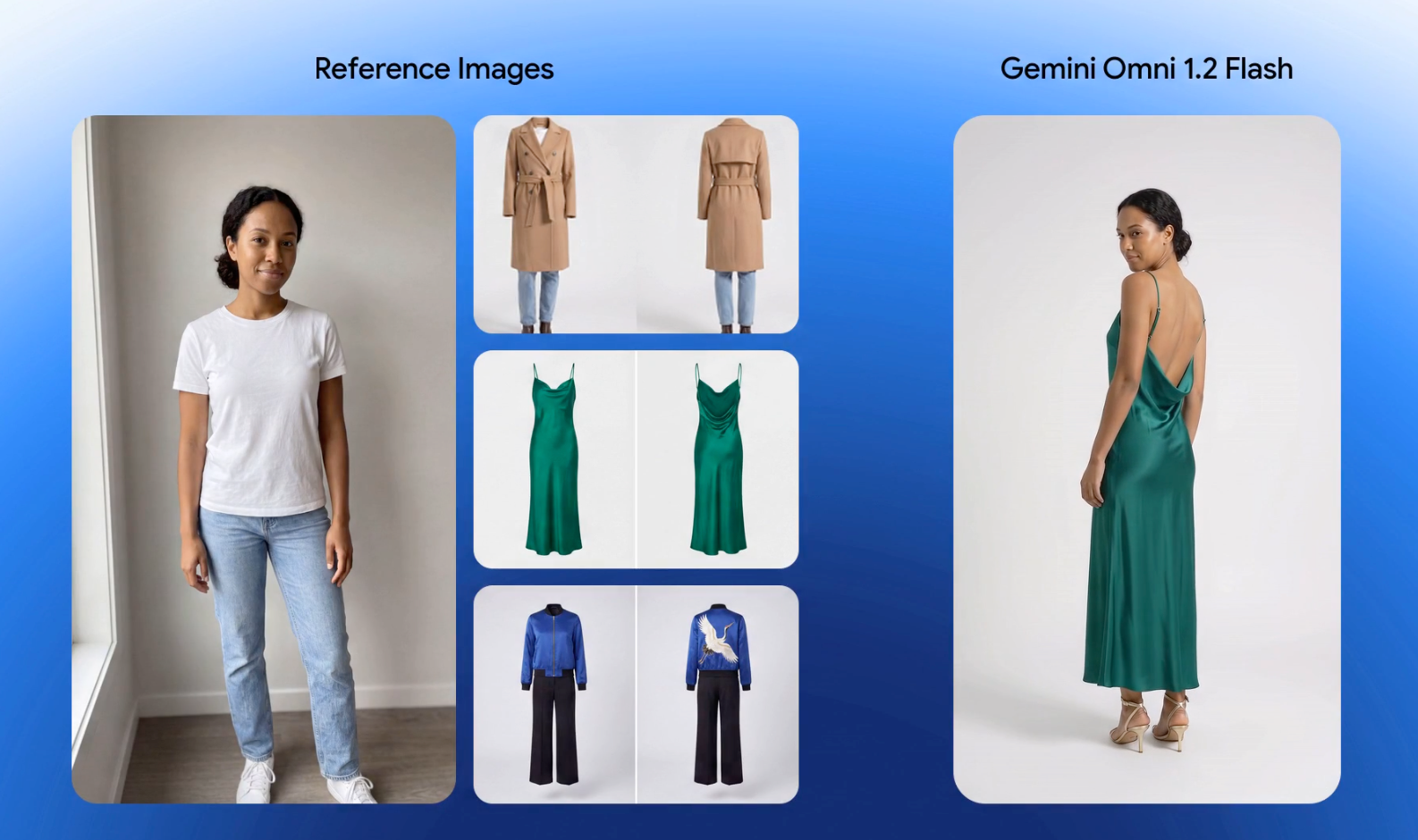
The result is the reusable part. In Google's worked example, the model receives a single photo of a model plus three product images of garments and returns one continuous 15-second shot containing a 360-degree turn, holding the person's identity and the cut and drape of each garment intact. For catalogue, marketplace and apparel teams, that single line replaces a shoot day, a stylist, a rig and a turntable.
Reconstructed as a repeatable pipeline, the run looks like this:
- Lock the reference pack first. One hero person image, product shots with legible packaging, an optional clip of up to 3 seconds for motion grammar, and an audio cue for pacing. Teams that skip this step spend their savings on retries.
- Draft cheap, not final. Generate the first pass at 360p or 720p.
- Edit in conversation. Replace the background, shift the lighting, change the aspect ratio — each instruction adjusts the existing footage instead of regenerating the whole video.
- Consistency check across angles. Verify faces, garment construction, packaging text and brand colour survive camera moves.
- Upscale once, at the end. Only the approved cut is lifted to 1080p or 4K.
- Export with provenance intact. Confirm the SynthID watermark and any Content Credentials metadata survive your asset-management and CDN steps.
Google also says the new model produces fewer visual drifts and deformations during motion and shot changes than the previous generation, generates smoother, more natural conversational speech with tighter lip-sync, can distinguish multiple speakers, and handles complex continuous camera moves such as FPV drone flights or fast pull-back shots with fewer unwanted jump cuts. Each of those items removes a specific reason teams used to abandon an AI clip mid-project.
Case 2: What an earlier Veo 3 brand run predicts about revision cost
Lesson from the previous cycle: the bottleneck migrated from rendering to reviewing. Google's own Think case study on UK brand The Wild Hare documents a small team producing more than 20 video assets with Veo 3 in a single afternoon, with total production cost cut by roughly 90% against a conventional shoot. Time saved was not spent on more renders — it was spent on more approvals, which is exactly where Conversational Editing bites: the reviewer's note becomes an instruction, and the clip changes without starting over.
The second lever is resolution economics, which Google's pricing pages make concrete: video output is metered through token conversion, with roughly 1,931 tokens billed per second of 360p footage versus 5,792 tokens per second at 720p. Layering a draft-at-low-res, upscale-once workflow on top of the announced 30% cut compounds the saving — the two levers are multiplicative, not additive, and that is the arithmetic a CFO will accept.
Where does provenance become somebody else's problem?
Every video this model outputs carries an invisible SynthID watermark identifying its origin — and since August 2026, that is a regulatory artefact rather than a vendor courtesy. The transparency obligations in Article 50 of the EU AI Act became applicable on 2 August 2026: providers of generative systems must mark synthetic audio, image and video in machine-readable form and enable detection, while deployers publishing deepfake-style footage must disclose its artificial origin, with penalties that can reach €15 million or 3% of global annual turnover.
Two operational traps follow, and both are routinely missed in vendor reviews:
- Two checks, not one. Google's own explainer on identifying AI-generated media notes that the C2PA Viewer reads Content Credentials but does not check SynthID or other watermarks. A clean “not detected” result does not prove provenance was lost.
- Transit destroys metadata. Re-encoding inside a digital asset manager, a social upload or a CDN pipeline can strip credentials even when the watermark survives — so the export path, not the model, decides your compliance posture.
The direction of travel is unmistakable: in August 2026, OpenAI announced it was adopting Content Credentials and SynthID for its own generated media, alongside a public verification tool. Marking is becoming an industry default, so buyers should design detection into their asset pipelines once, model-agnostically, instead of retrofitting per vendor.
Who should adopt now, and who should wait a cycle?
| Profile | Fit today | Watch-out |
|---|---|---|
| E-commerce and DTC merchandising | Strong — reference images plus a 15-second turn or unboxing beat | Packaging text must be verified frame by frame at your real thumbnail size. |
| SaaS marketing and product ops | Strong — feature demos and explainer clips via Google Vids and Flow before API work | Long-form narratives still require stitching several 15-second segments. |
| Performance teams on Google Ads | Strong — variant volume is now affordable at $0.07 per second | Approvals must move from “pick one” to “test many”, or the saving is stranded. |
| Regulated or heavily lawyered brand spots | Marginal | Human verification of likeness, claims and provenance evidence is not automated. |
| Broadcast-grade hero films | Marginal | Shot-level motion control and 3-second reference ceiling still bound the brief. |
What should software buyers do in the next 30 days?
- Price per finished minute, not per clip. Run a bake-off on your own SKUs and compare draft-tier and final-tier spend.
- Write the tiering rule into the workflow. Default every job to 360p or 720p; 1080p and 4K only on signed-off cuts.
- Build a reference library before prompts. Standardise model images, product photography, motion clips up to 3 seconds and audio cues per brand system.
- Instrument revision cycles. Track how many conversational edits reach an approved clip; if the number climbs, your savings are being consumed by review, not rendering.
- Test provenance end to end. Verify the SynthID watermark and Content Credentials survive export, upload and re-encode.
- Amend contracts. Ask vendors how they handle machine-readable marking, detection APIs and metadata retention under Article 50 of the EU AI Act.
Frequently asked questions
Is Gemini Omni 1.2 Flash cheaper than the version before it?
Yes. Google cut 720p generation pricing by 30% versus the previous generation, to $0.07 per second of finished video.
How long can a single clip be, and can it be edited partially?
Clips can be set from 3 to 15 seconds, up from a 10-second maximum. Through Conversational Editing, users adjust elements such as background, lighting or aspect ratio across the full 15-second duration instead of regenerating the entire video.
What inputs does the model accept as references?
According to Google's announcement, users can supply a person's image, product photos, a short video of up to 3 seconds, and audio prompts, and the model should hold faces, clothing, packaging text and brand colours consistent across camera angles.
Do generated videos carry a visible label?
No — every output embeds the imperceptible SynthID watermark to identify its origin. Visible disclosure and machine-readable detectability are separate obligations under EU AI Act Article 50, and each is a different engineering task.
Where is the model available?
Google says rollout is staged across Gemini API, Google AI Studio, Google Cloud Console, Flow, Google Vids, the Gemini app for Google AI Ultra subscribers, and Google Ads. Availability and limits differ by surface and by subscription tier, so confirm entitlement per account before budgeting.
Reference sources
- Google, “Gemini Omni 1.2 Flash: 15-second video and lower pricing” — blog.google
- Google AI Studio documentation, “Generate and edit videos with Gemini Omni Flash” — aistudio.google.com
- Google Cloud Model Garden pricing, token rates for video output — cloud.google.com
- Google Think UK case study, “Veo 3 case study: AI cut video costs by 90%” — business.google.com
- European Commission guidelines on transparency obligations (Article 50) — digital-strategy.ec.europa.eu
- Google, “Tools to understand how content was created and edited” (C2PA and SynthID detection limits) — blog.google
- OpenAI, “Advancing content provenance for a safer, more transparent AI ecosystem” — openai.com
- Content Credentials / C2PA ecosystem overview — contentcredentials.org
Prepared by the GlobalSaaSManager editorial team (Kai Brooks). For product, procurement or coverage questions, contact info@globalsaasmanager.com.