
SaaS Decision Q&A: What the First Wave of gen AI Marketing Adoption Really Means
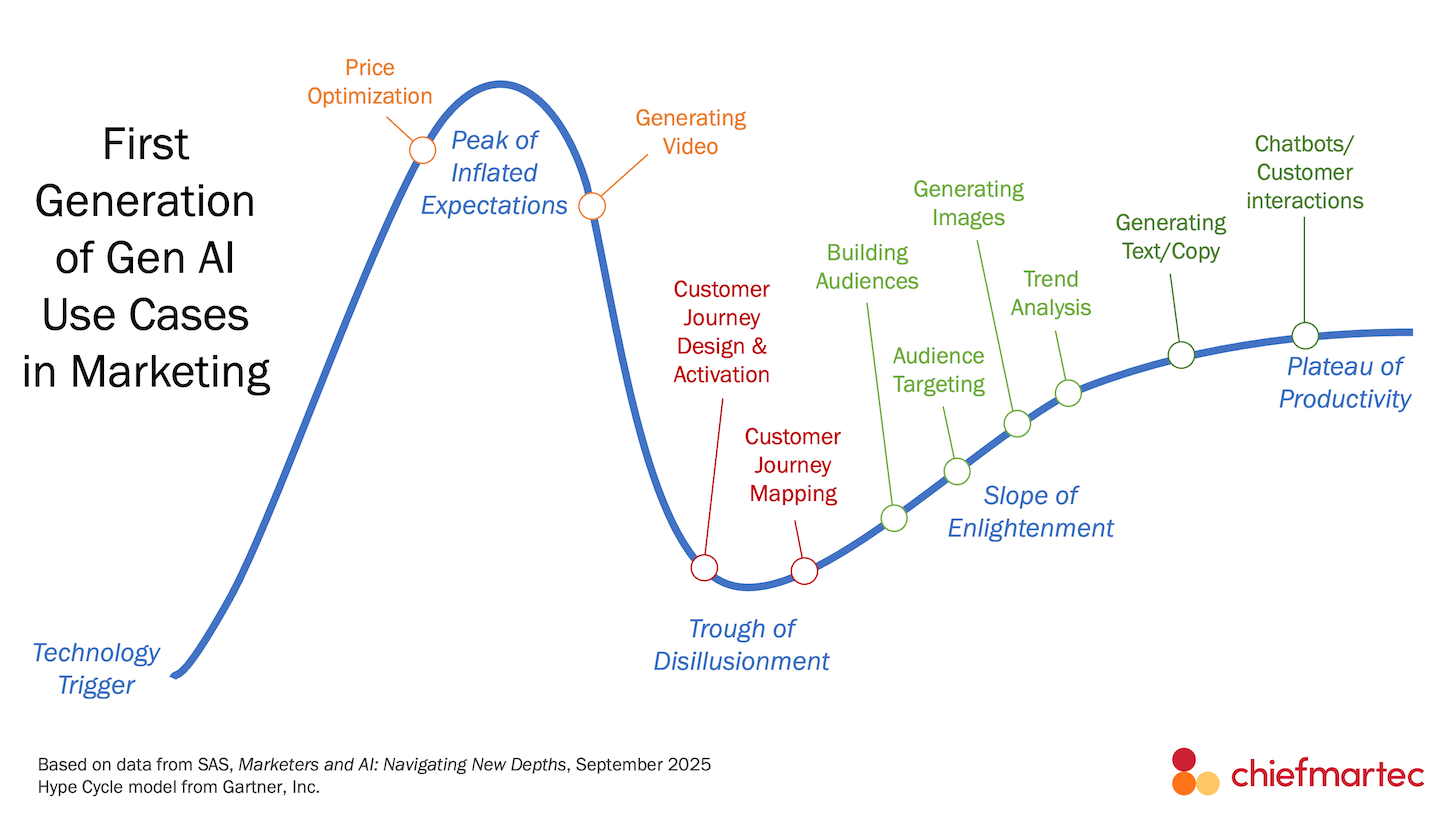
The practical answer for SaaS buyers and builders is narrow: first-generation gen AI is already most defensible in chatbot and customer-interaction workflows, text generation, and trend analysis, while video generation and journey mapping are cooling. Read the new SAS figures as a procurement filter, not a verdict on AI itself.
For GlobalSaaSManager’s SaaSIndustryNews audience, the question is not whether artificial intelligence will matter. The question is which marketing software features already earn recurring budget, which are losing credibility, and how quickly product teams need to respond before the next generation resets expectations.
Why the first wave is not a single verdict
The first point of confusion is terminology. “gen AI” is not one technology moving along one curve. It is a bundle of model capabilities, integration patterns, data requirements, and workflow promises. A chatbot, a video generator, and a trend-analysis assistant are not commercially interchangeable even when vendors package them under the same AI label.
Many of these applications are still first generation. Expectations for a good AI-powered chatbot today are modest compared with what buyers may demand in 2 years, 5 years, 10 years. The same product category can look mature at the workflow layer and immature at the agent layer.
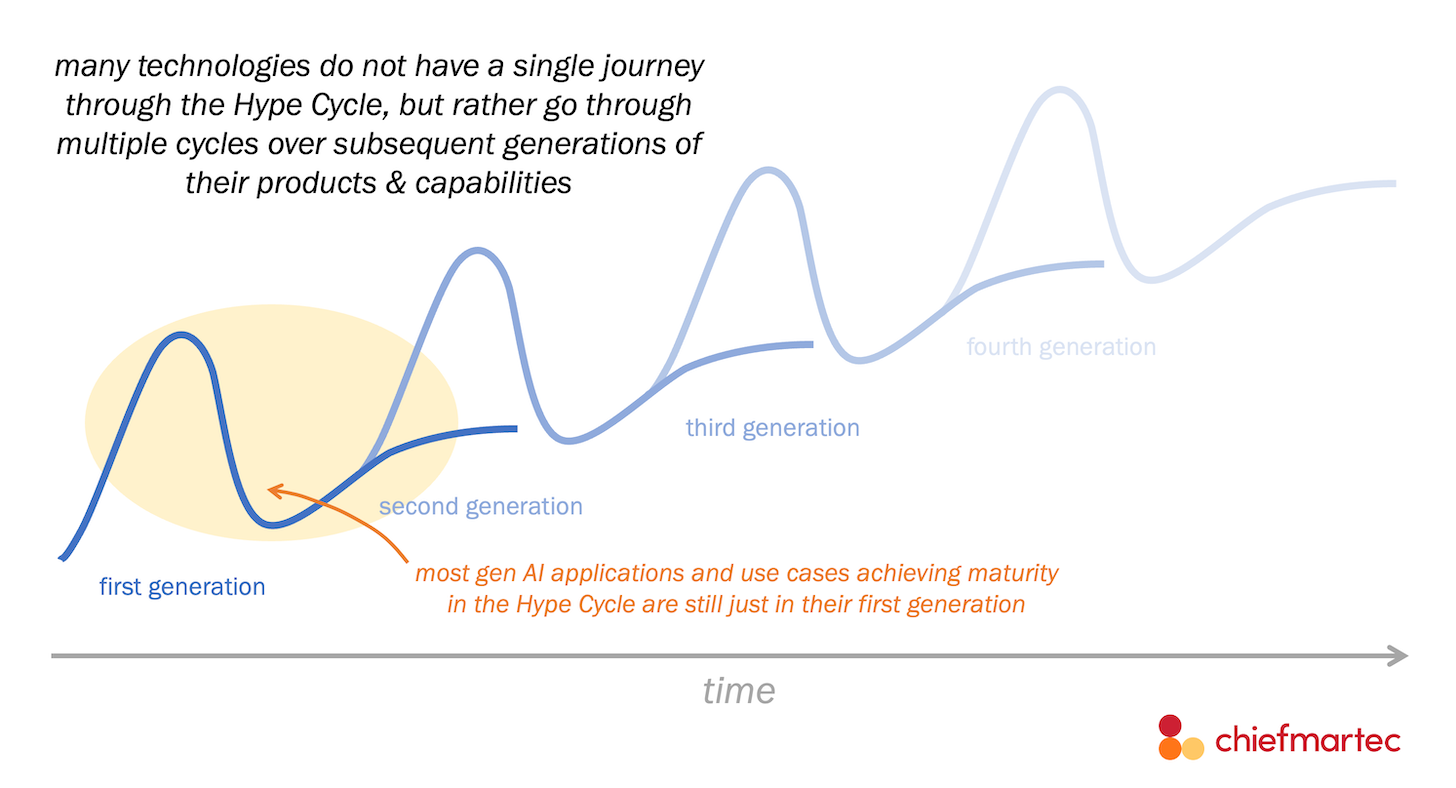
Each generation may follow its own expectations cycle. A vendor can reasonably describe a current customer-service assistant as useful while also admitting that autonomous AI agents are still overhyped. That is not a contradiction; it is a different generation on the map.
This is where F. Scott Fitzgerald’s point about holding two opposing ideas at once becomes practical. For product owners, the useful question is not “is chatbot AI ready?” but “which generation of chatbot AI is ready, and for which job?”
What did the new SAS report measure?
A useful data point arrives from a new report released by SAS this week, “Marketers and AI: Navigating New Depths.” It compares adoption and planning across 10 gen AI applications in marketing in 2024 and 2025, with n=300 for both years. That structure matters because it converts a broad AI debate into measurable product decisions.
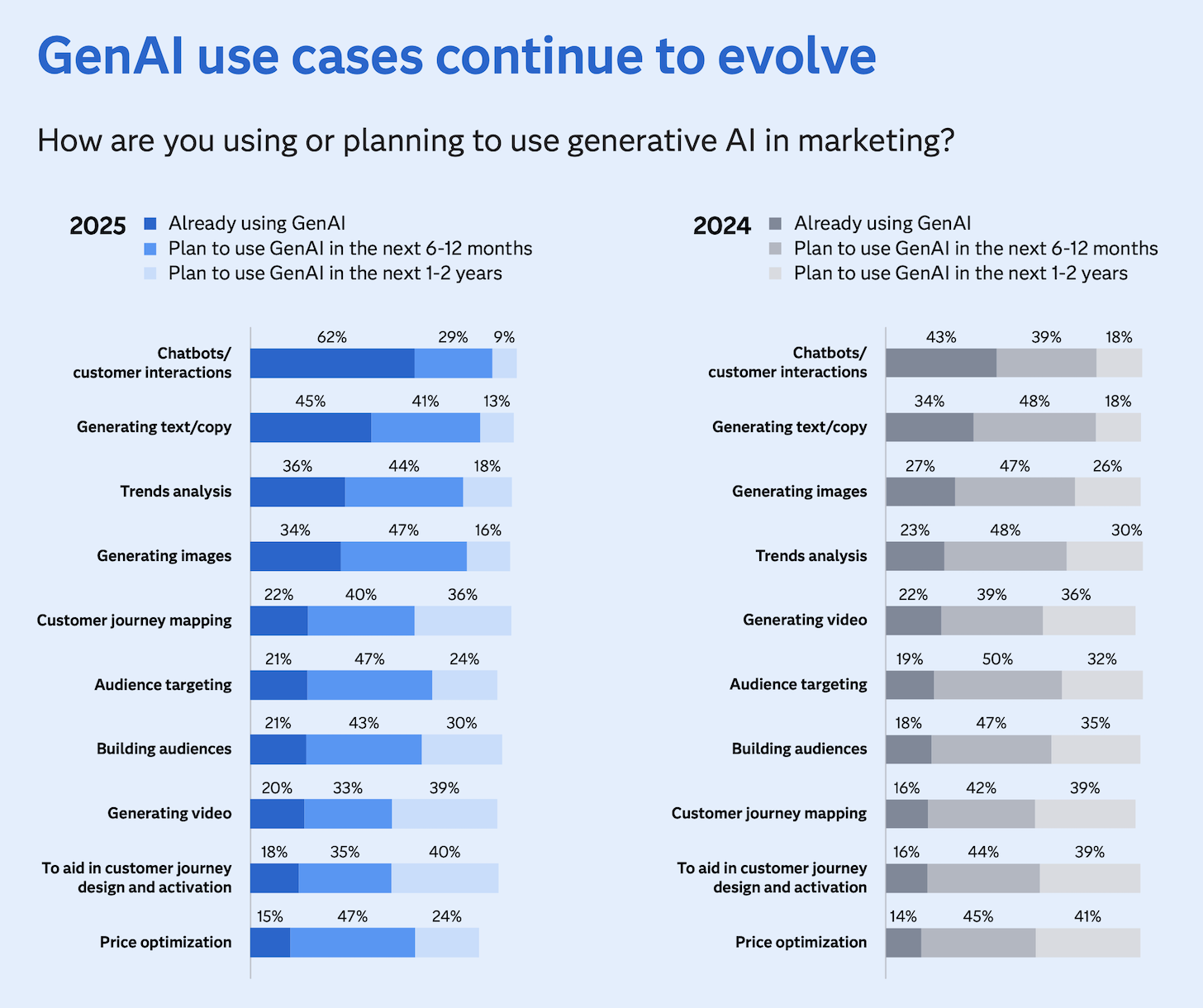
The strongest 12-month acceleration in adoption appears in:
- Trends analysis: +56.5%
- Chatbots/customer interactions: +44.2%
- Generating text/copy: +32.4%
Those are also the three leading adoption areas: chatbots and customer interactions reach 62%, text and copy generation reaches 45%, and trends analysis reaches 36%. For a SaaS roadmap, that is a signal that these three are closer to baseline features than optional experiments.
However, two use cases reversed direction in this past year:
| First-generation gen AI use case | Change in adoption | Why buyers should care |
|---|---|---|
| Generating video | -9.1% | Output quality, brand safety, and production workflow fit are still difficult to standardize. |
| Customer journey mapping | -4.3% | The idea drew much attention a year ago, but cross-system data access and measurement remain the hard part. |
The table gives SaaS buyers a simple sorting rule: if a use case is gaining adoption and already reaches a high share, test it as a core workflow; if adoption is falling after a year ago’s excitement, demand clearer evidence of workflow fit before expanding budget.
How fast is the cycle moving?
The second structural change is speed. The distance between “new capability” and “expected capability” is shrinking. What once took much longer to become a mainstream workflow is now being attempted in a couple of years. For SaaS vendors, that compresses differentiation. For investors, it raises the risk that a product category is priced for next-generation performance while still delivering first-generation output.
This is why “AI” as a label is less useful than “AI job to be done.” A marketing team may pay for reliable copy drafting now, but it should not underwrite a full autonomous journey-orchestration roadmap without staged milestones.
Where do the applications sit for decision-making?
Based on the SAS data and broader martech observation, the most adopted first-generation use cases can be read as “Plateau of Productivity” candidates. The applications losing adoption after much earlier fanfare can be read as “Trough of Disillusionment” candidates. This is not an official ranking: Gartner did not create this map, and the placement is an interpretive decision aid rather than a definitive score.
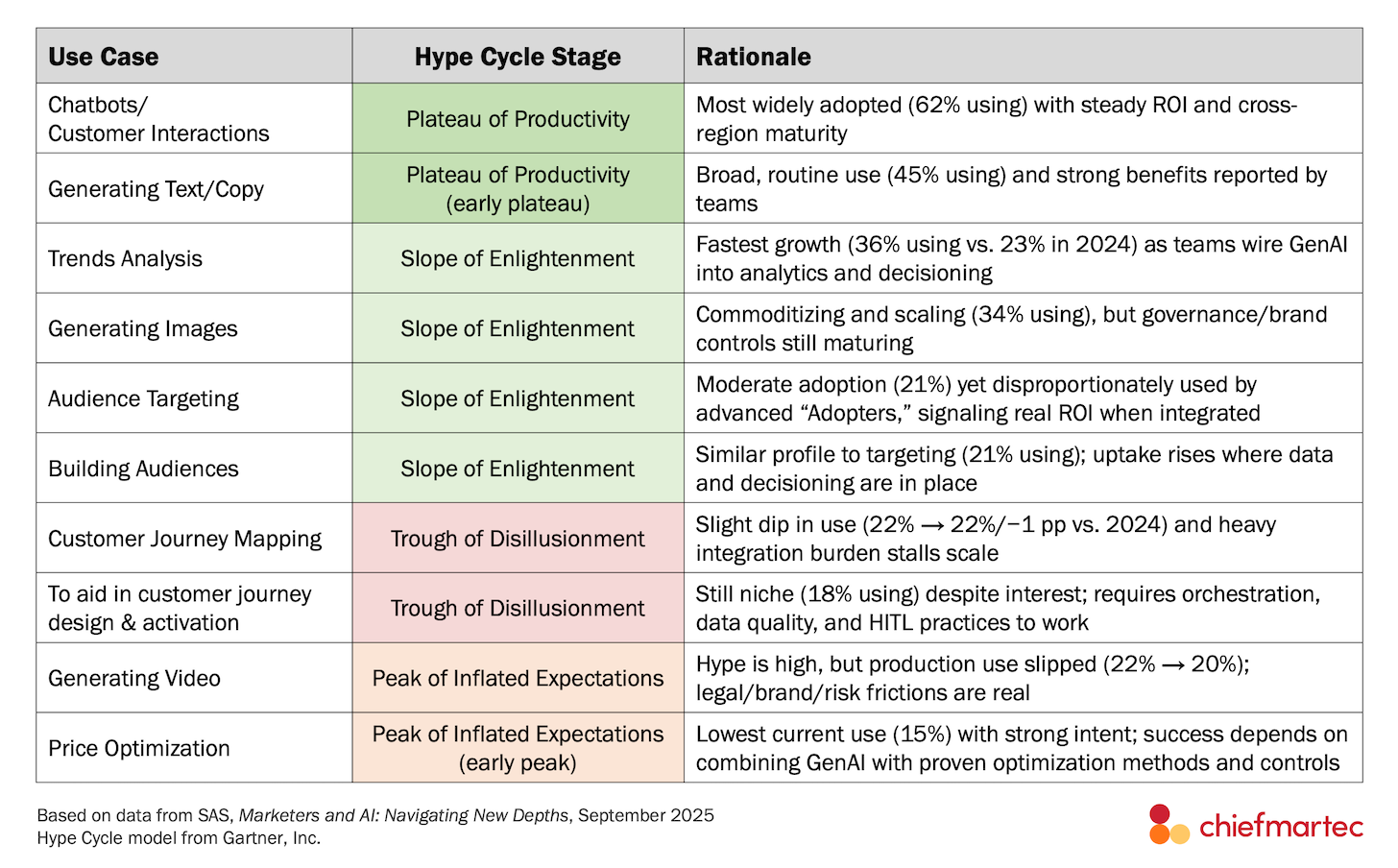
The point is not to label tools as winners or losers. The point is to align purchase decisions with the generation of capability being sold. Chatbots, text generation, and trend analysis may be defensible today; video and journey mapping may need more data plumbing before they become dependable.
What should founders, product leaders, and buyers do next?
For founders and product leaders, the practical response is to build toward the next generation without overpromising the current one. The current opportunity is narrow and executable: make the first-generation use case measurable, integrate it with customer data, and connect it to an operator’s workflow. A McKinsey & Company view is particularly useful here: Ariel Kelman notes that the initial adoption of gen AI is heavier in service and sales, and advises companies to start with gen AI features in their SaaS applications while getting customer data organized. That is a procurement warning as well: the app is easy to buy; the data layer is often the real project.
Later market data reinforces the caution. In its 2026 marketing organization research, McKinsey reported that nearly 60 percent of marketers use AI multiple times per week, but less than 10 percent have started capturing value across end-to-end workflows. This does not contradict the SAS adoption figures; it refines them. Adoption can be broad, and value capture can still be narrow.
A short decision checklist
- Buyers: prioritize chatbots, text generation, and trends analysis as near-term features, but require clear ROI metrics before treating them as transformational.
- Product owners: treat the 62%, 45%, and 36% adoption points as evidence that workflow depth matters more than AI labels.
- Investors: discount claims that a first-generation assistant is equivalent to an autonomous agent; compare the generation being sold with the generation that is already paid for.
- Security and governance leaders: use the cooling of journey mapping as a cue to inspect data access, consent, measurement, and cross-channel attribution before investing more.
FAQ: high-frequency decision questions
Is gen AI in marketing overheated?
Not evenly. The data shows strong adoption in some first-generation use cases and declines in others. The better answer is “different curves,” not “one bubble.”
Which gen AI marketing features are most defensible now?
Chatbots and customer interactions, text/copy generation, and trends analysis are the clearest candidates, based on the highest adoption levels and the strongest 12-month acceleration.
Should companies stop buying AI video or journey-mapping tools?
Not necessarily. A decline in adoption is a signal that expectations are being corrected, not that the capability is permanently useless. It suggests buyers should demand better workflow proof, not just model claims.
What is the biggest risk for SaaS vendors?
Marketing a first-generation feature as if it were a next-generation platform. If buyers cannot connect the tool to measurable outcomes, the vendor may face a faster disillusionment cycle than in earlier software eras.
How often should teams revisit these priorities?
Quarterly. The cycle is accelerating, and a category can move from “early win” to “baseline requirement” before the next planning season.
Bottom line for SaaS managers
The first wave of gen AI in marketing is not a single adoption story. It is a set of short, uneven product decisions: buy where adoption is proven, pilot where adoption is falling, and avoid conflating current features with future autonomous systems. The most useful takeaway from the SAS report is a disciplined one: use the numbers to decide what to procure, what to build, and what to measure.
References
- SAS, “Marketers and AI: Navigating New Depths” report overview: https://www.sas.com/en/offers/dive-shallow.html
- Chief Martec, “The first generation of gen AI use cases in marketing are streaking through the Hype Cycle”: https://chiefmartec.com/2025/09/the-first-generation-of-gen-ai-use-cases-in-marketing-are-streaking-through-the-hype-cycle/
- McKinsey & Company, “A new tech-driven era of impactful marketing and sales”: https://www.mckinsey.com/capabilities/growth-marketing-and-sales/our-insights/a-new-tech-driven-era-of-impactful-marketing-and-sales
- McKinsey & Company, “From anxiety to advantage: A marketing organization that thrives with AI”: https://www.mckinsey.com/capabilities/growth-marketing-and-sales/our-insights/from-anxiety-to-advantage-a-marketing-organization-that-thrives-with-ai