
Case Replay: Inside the ChatGPT GIF Workflow — What Images 2.6 Means for SaaS Product Teams
OpenAI's Images 2.6 update now creates an animated GIF inside a single conversation, adds playback-speed control, per-frame editing and sharing in the same thread, and shortens image generation time. Weekly output across ChatGPT and the API has passed 4 billion images, up from 3 billion images per week this September. This GlobalSaaSManager case replay walks through the rollout itself — the workflow, the numbers, the cost mechanics — and extracts the reusable lessons for product, growth and procurement owners.
What actually shipped with Images 2.6
The short answer: the interesting change is not the file format, it is the disappearance of a multi-step production pipeline.
- Native motion output. ChatGPT returns a GIF directly, rather than static images that a user exports, animates and re-encodes elsewhere.
- Editable, not disposable. OpenAI says users can change playback speed and inspect or modify a single frame instead of regenerating the whole animation — the part that historically made AI motion assets expensive to iterate on.
- Speed as the headline metric. OpenAI frames Images 2.6 as a faster model line, continuing the ~50% generation-time reduction it advertised with ChatGPT Images 2.5 on 8 September 2026 (openai.com); press reporting on 2.6 describes a comparable gain over the previous version, with the Flare API tier returning an image in as little as six seconds at low quality settings.
- Two API models for developers. GPT-Image-2.6 Flare prioritises throughput; GPT-Image-2.6 Sunburst prioritises fidelity, detail control and consistency of characters, products and brand elements across repeated edits.
- Broad availability. OpenAI says Images 2.6 and GIF generation are rolling out to all ChatGPT and Codex users on web, desktop and mobile.
Case replay: one prompt, one GIF, one editable frame
The clearest way to read the update is to replay OpenAI's own demonstration step by step, because each step removes a task that used to sit in a different tool.
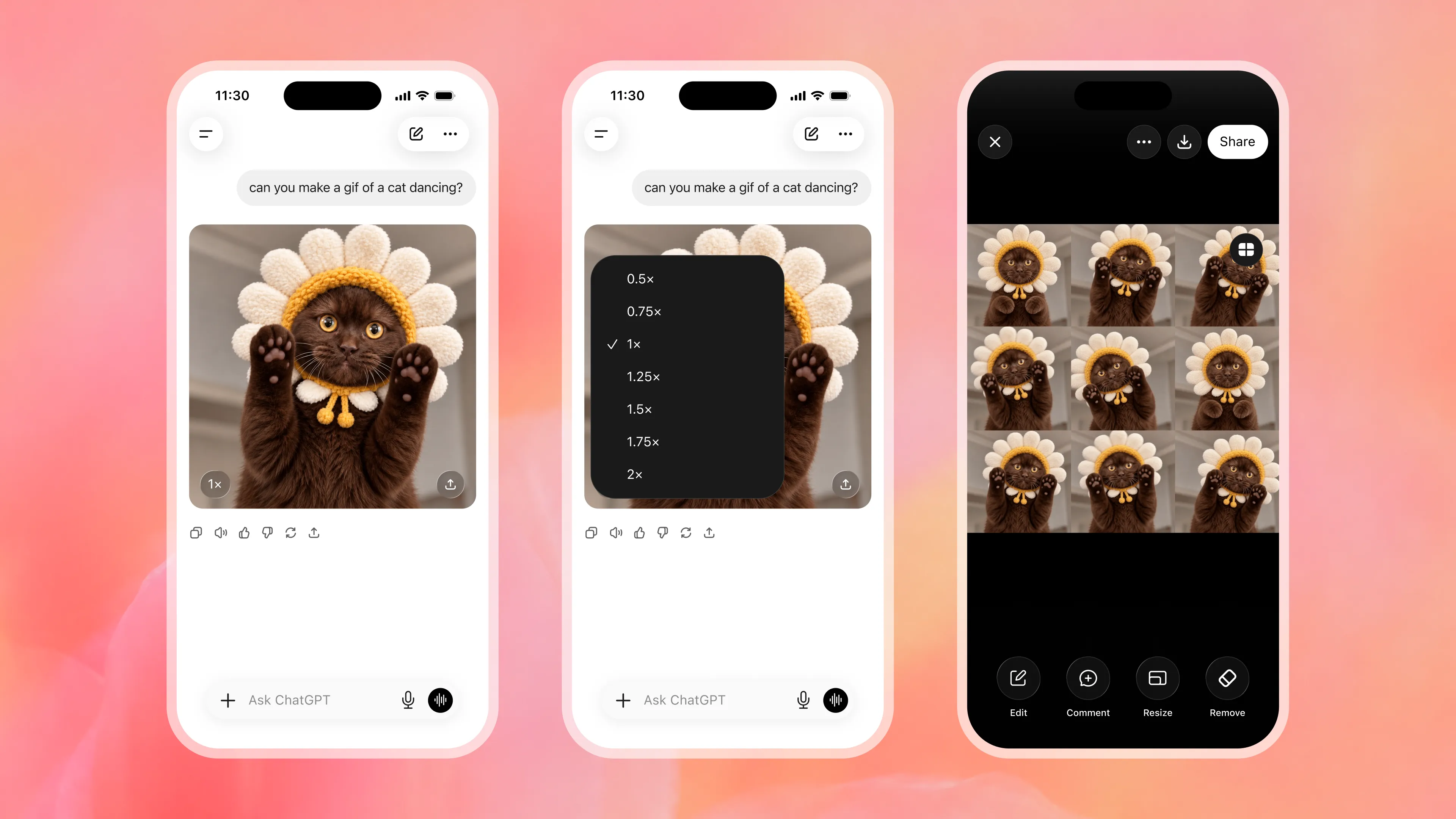
- Request. A user types the demo prompt — essentially, "Can you make a GIF of a dancing cat?" — in one conversation. No node graph, no timeline editor, no export settings.
- Delivery. ChatGPT returns an animated result in-thread, so the asset lives where the brief, the feedback and the approval history already live.
- Pacing. The interface exposes playback-speed control, letting the same animation serve a fast reaction clip or a slower product loop.
- Frame-level repair. A frame-by-frame view lets the user fix the one bad frame. This is the operational win: the cost of an iteration drops from "regenerate everything" to "touch what broke".
- Sharing. The finished GIF is shareable directly, shortening the handoff from creator to channel owner.
Result. A workflow that previously required an image model, an animation or GIF assembler and a manual round-trip now fits inside one conversation, with no animation skill required — the point OpenAI itself stresses, and the reason The Verge characterised the launch (4 November 2026) as ChatGPT becoming a place where people "will now make you animated GIFs" rather than a place where people only draft text.
Reusable lesson for product teams. When a model vendor converts an output into an editable object, the competitive bar moves from "can we generate it?" to "how cheaply can we revise it?". Any AI feature roadmap that counts generation calls but not revision cycles will systematically underestimate its own value — and its own cost.
The volume curve matters more than the feature
Conclusion: demand for AI image output is compounding faster than most enterprise content budgets assume, and that trajectory — not the GIF button — is what should trigger planning.
| Checkpoint | Reported weekly image volume | Why it matters |
|---|---|---|
| June 2026 (OpenAI post on X) | over 1.5 billion images per week in ChatGPT | Baseline before the two-tier model split |
| This September | 3 billion images per week | Reported alongside ChatGPT Images 2.5 and the arrival of ads testing |
| 4 November 2026 | more than 4 billion images | OpenAI's current figure across ChatGPT and the API — a ~33% jump in roughly two months |
Two operational readings follow. First, latency and quality claims are being made into a capacity crunch: a 33% volume increase in under two months explains why OpenAI split its developer line into a speed tier and a quality tier rather than shipping one model. Second, volume attracts monetisation. Inc. reported in early October that ChatGPT was creating 3 billion images a week and that advertising was about to enter that surface — a signal that "free-ish" creative capacity may be paid for in prominence, not in tokens.
Flare versus Sunburst: how to pick the right API model
Conclusion: treat the tiers as a routing decision, not a pricing decision. OpenAI published identical token rates for both tiers of the previous line — USD 5 per million text-input tokens, USD 8 per million image-input tokens and USD 30 per million image-output tokens (OpenAI model pages, checked 9 September 2026) — yet identical rates do not produce identical bills, because token consumption per image is not fixed.
| Dimension | GPT-Image-2.6 Flare | GPT-Image-2.6 Sunburst |
|---|---|---|
| Design goal | Speed, high-volume output | Fidelity and edit consistency |
| Best fit | Variant exploration, in-product asset generation, A/B creative at scale | Production ad sets, product shots, character or brand systems |
| Speed signal | Reported to return images in as little as six seconds at low quality | Slower by design; buys detail control |
| Failure mode | More retries, so cost lands in "wasted" generations | Higher spend per accepted asset if used for drafts |
| Recommended pattern | Generate directions cheaply, then hand the chosen image plus explicit change notes to the quality tier | Reserve for the final pass and anything a customer will see |
The API surface also gains features that matter to engineering rather than marketing: annotation-based editing, SVG export and a complexity parameter. OpenAI describes annotation editing as a transparent PNG overlaid on the first input image to guide a targeted edit (as summarised from its documentation by EvoLink's 28 October 2026 analysis) — a primitive that makes "fix the left third only" programmable instead of conversational.
Second case: the capability arrives inside suites your team already bought
ChatGPT is not the only place these models now surface. Adobe lists GPT Image as a partner model inside Firefly (adobe.com/products/firefly/partner-models), alongside competing third-party models, letting creative teams pick a model per task without ever opening a chatbot.
- For buyers: expect model choice to become a checkbox inside incumbent software, so your evaluation criteria shift to routing, logging and data handling, not "which model is best".
- For SaaS founders: being a partner model in someone else's workflow is now a distribution strategy that costs no sales headcount — and it means a competitor can match your AI feature without training anything.
- For platform risk: capabilities move through the stack fast. A feature that differentiates a product in Q4 can be a vendor checkbox in Q1.
Risks to price into the workflow
- Brand drift at speed. Better character, product and brand consistency lowers the human review barrier precisely when output volume rises; off-brand assets ship faster when approval is implicit.
- Provenance of inputs. Photo-to-GIF generation requires clear rules on which source images may be uploaded — people, trademarks, unreleased products.
- Cost per accepted asset, not per image. Include prompts, references, retries and human fixes in the denominator; batches that deliver no approved asset have no meaningful average cost.
- Vendor coupling of the artefact. Once the edit history, frame revisions and sharing all live in one conversation, exporting that workflow to another tool is expensive.
- Monetisation drift. Testing of advertising inside image generation in the US suggests the economics of "free" creative capacity are still being written.
Action checklist for the next 30 days
- Map one existing motion-asset workflow end to end and count revision rounds, not generations; that count is your baseline.
- Run a paired test of the speed tier and the quality tier on the same 20 briefs, and report cost per accepted asset for each.
- Abstract the model name out of your product code behind one routing layer, so a 2.5-to-2.6 style refresh is a config change, not a sprint.
- Set a written approval gate for any generated or edited asset that carries a logo, a face or a product.
- Re-read your AI spend line with volume growth priced in: a 33% jump in two months is the planning assumption, not last quarter's average.
FAQ: what SaaS buyers are asking about ChatGPT GIF generation
Can ChatGPT produce animated GIFs directly now?
Yes. With Images 2.6, a GIF can be created inside one conversation, with playback-speed control, frame viewing and single-frame editing, plus sharing of the finished file.
Which users get it?
OpenAI states that Images 2.6 and GIF generation are being rolled out to all ChatGPT and Codex users across web, desktop and mobile. Plan-level caps are not published in OpenAI's rollout message, so confirm entitlement in your own workspace settings before promising availability to a team.
Does frame editing replace motion-design software?
For short loops, reaction-style clips and simple product animations, it removes most of the toolchain. For long-form, timeline-graded or broadcast work, it is a speed and cost story rather than a replacement.
How should we budget the two API models?
Model cost as consumption, not as a per-image price list. Both tiers of the previous line shared token rates, but per-image token use is not published as a fixed number, so run a measured pilot and track cost per accepted asset.
What is the single most useful takeaway from this case?
That the durable advantage in AI creative tooling is editability. Anyone can generate; the products and teams that win are the ones that make revision nearly free — which is exactly what a per-frame edit inside a chat thread does.
Sources
- The Verge — "ChatGPT will now make you animated GIFs" (4 November 2026): https://www.theverge.com/ai-artificial-intelligence/1026474/openai-chatgpt-animated-gifs-images-2-6
- OpenAI — "Introducing ChatGPT Images 2.5" (8 September 2026): https://openai.com/index/introducing-chatgpt-images-2-5/
- Inc. — "ChatGPT Creates 3 Billion Images a Week. Now Ads Are About to Enter the Picture" (October 2026): https://www.inc.com/aaron-mok/chatgpt-creates-3-billion-images-a-week-now-ads-are-about-to-enter-the-picture/91414977
- Adobe — GPT Image as a Firefly partner model: https://www.adobe.com/products/firefly/partner-models/gpt-image.html
- EvoLink — analysis of GPT Image 2.6 documentation and annotation-editing behaviour (28 October 2026): https://evolink.ai/blog/gpt-image-2-6-leak
- Sina Finance / Jiemian News — Images 2.6 speed, GIF, SVG export and Flare six-second reporting (5 November 2026): https://cj.sina.cn/articles/view/5182171545/134e1a99902002l7e6
Written by Kai Brooks, GlobalSaaSManager — SaaSIndustryNews desk. Corrections and document requests: info@globalsaasmanager.com