
Buyer-Controlled AI Agents, Not Marketer Tools: A SaaS Leader's Decision Q&A Before December 2
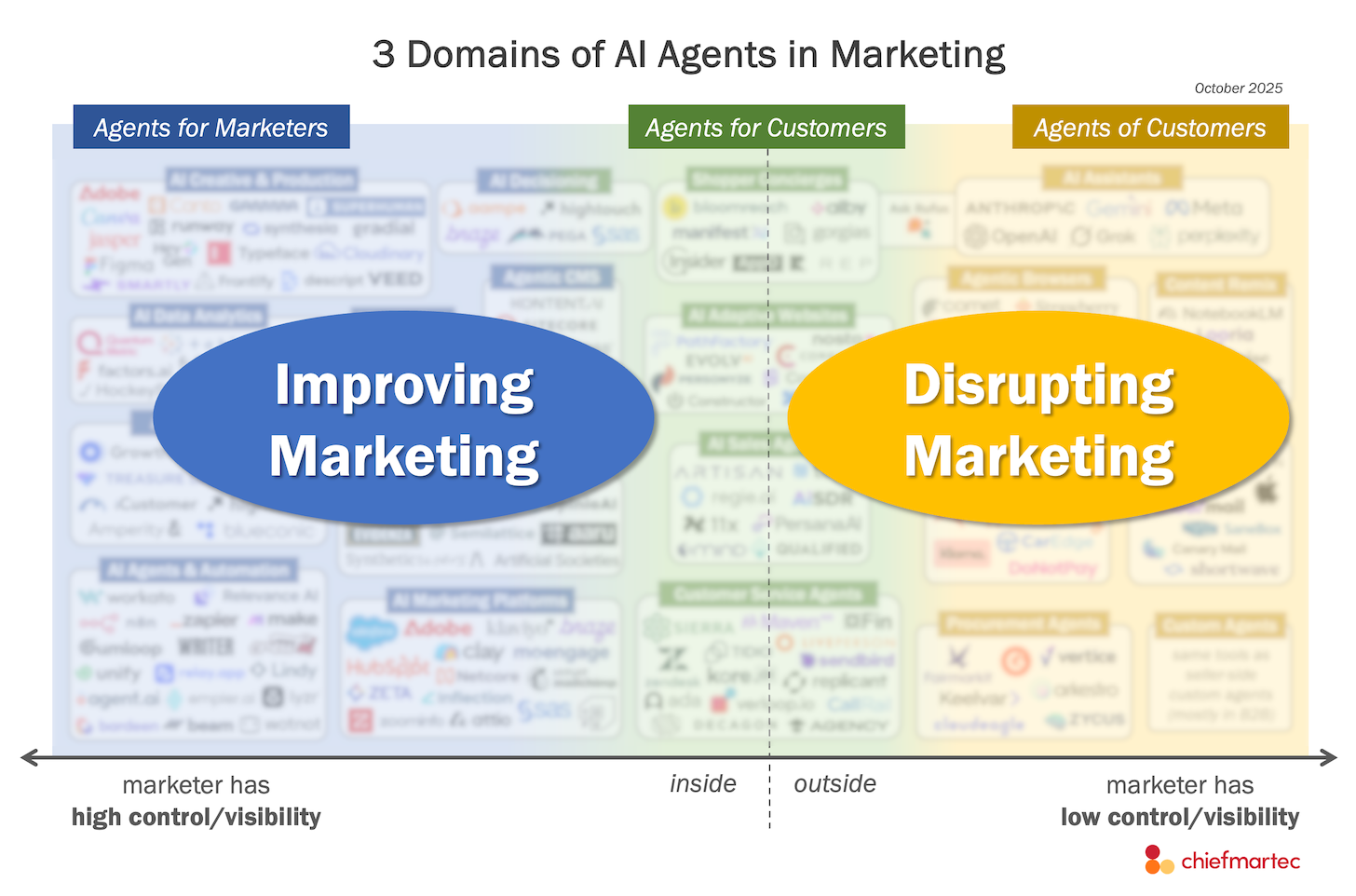
Short answer: the disruption that should reorganise a software company's go-to-market plan is not the agent sitting inside its own martech stack — it is the agent working for the buyer. The Martech for 2026 report, released December 2, concludes that buyer-controlled assistants now intervene in how customers find, compare and purchase both consumer brands and enterprise software, moving ownership of the upper funnel away from the vendor.
For founders, investors and enterprise procurement teams, that reframing changes the arithmetic rather than the vocabulary. If an intermediary builds the shortlist, the assets that win deals shift from ranked pages and paid placements toward machine-readable product facts, transaction endpoints and measurable attribution. The eight questions below split the report's claims into the concrete decisions they force, along with the evidence that supports or limits each one.
Q1. Is the agentic wave in martech real, or just vendor messaging?
Answer: real, but overwhelmingly seller-side. In the AI & Data in Marketing study underpinning the report, 90.3% of participants reported using AI agents somewhere in their martech stack, including where the use was exploratory or confined to a narrow production workflow.

Read the sample with care. Those respondents are more technically fluent than the average marketing department, yet they operate martech and marketing operations inside major B2C and B2B brands, which makes their behaviour a leading indicator instead of an artefact of early adopters. What they describe is adoption that improves marketing: hundreds of new agentic tools plus hundreds of agents appended to existing martech platforms, brainstorming, producing, distributing and analysing campaigns. A number of executives recast efficiency as strategy through the do more with less cliché; in the best cases effectiveness rises too. Even then, nearly all of the gain is incremental, however significant it looks line by line.
Q2. Where is the disruption that actually moves revenue?
Answer: on the demand side, starting with search itself. The report's sharpest claim concerns the displacement of classic Google search — and of the SEO playbooks marketers refined across the past 25 years to win that channel — by assistants such as ChatGPT, Claude, Perplexity and Google's own Gemini platform.
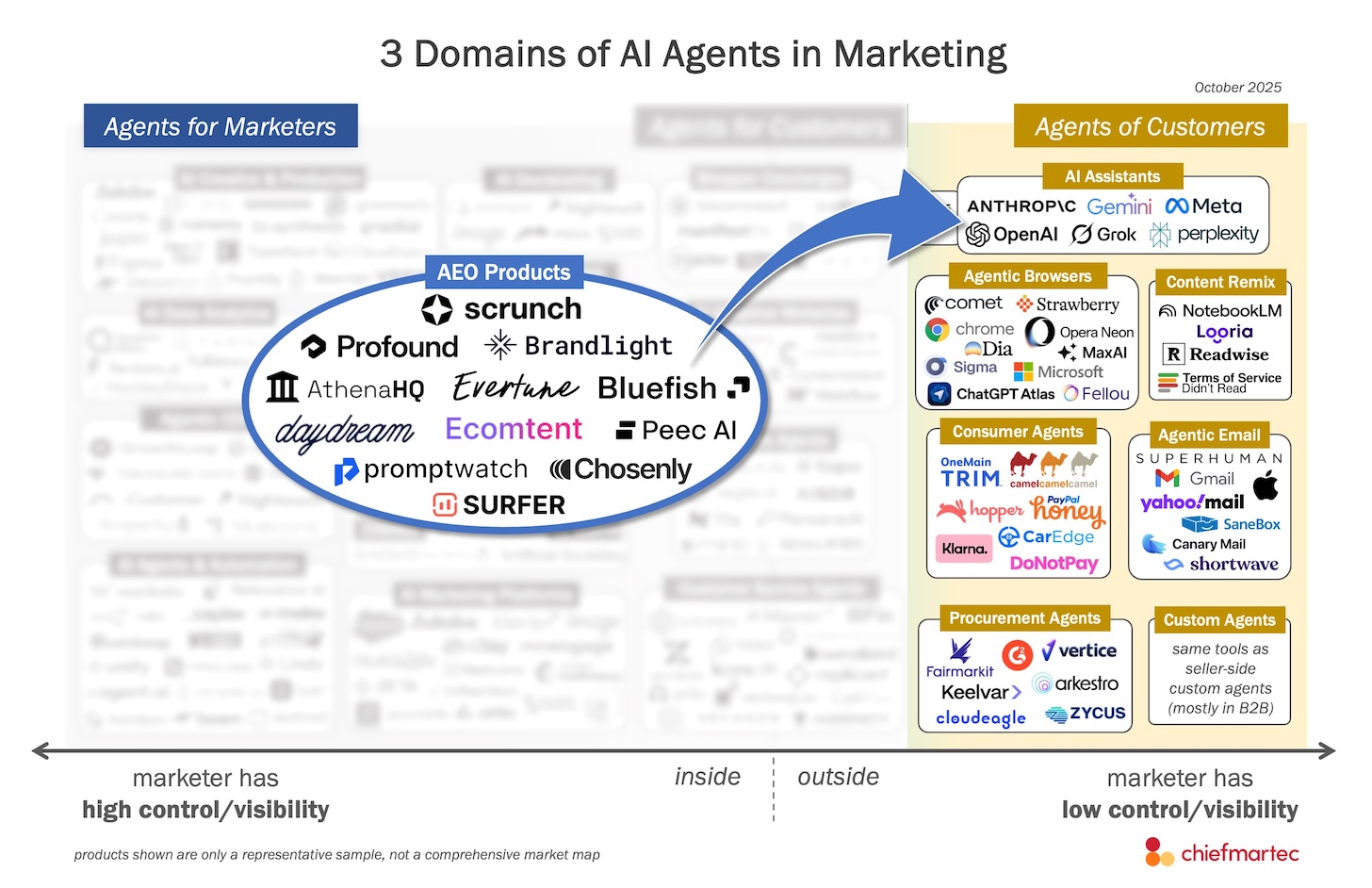
Buyer-side agents count as true disruptors because they are rewriting how buyers find, evaluate and engage with brands and vendors. In what the report names the Great Rewiring of the Buyer's Journey, marketing teams lose visibility and control. A whole category of AEO (answer engine optimization) products has formed to attack the problem and is growing fast, yet those products remain early while the environment they track advances more quickly; the authors characterise the pursuit as "like chasing a bullet train with a bicycle."
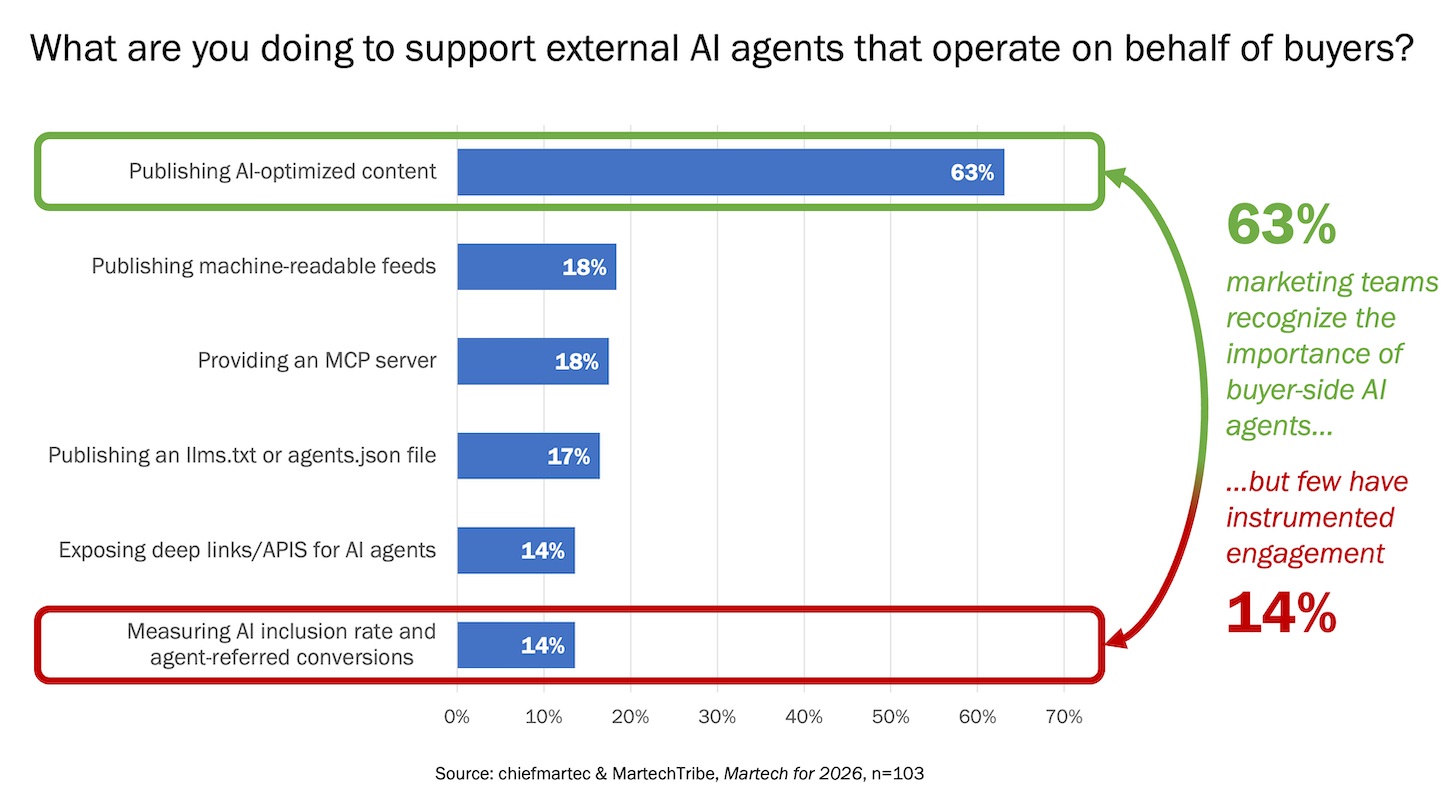
Two figures from the same research establish the maturity curve: 63% of marketing teams recognise the shift in buyer search channels and behaviours and are deliberately adapting content strategy, while only 14% have instrumented it. Closing that measurement gap is expected to rank as a 2026 priority.
Q3. Does evidence outside the report corroborate the buyer shift?
Answer: yes for research behaviour, not yet for full delegation of purchasing. Three verifiable external data points frame how far to push planning:
- G2's Answer Economy research, published April 2026 from a survey of 1,076 B2B software buyers, found 51% now start research with an AI chatbot more often than with Google — up from 29% a year earlier — and 71% rely on chatbots somewhere in evaluation.
- A July 2026 follow-up from G2 on buyer behaviour reported 61% of buyers currently use or plan to use AI agents in the buying process, with a further 19% open to them for selected tasks: real traction, still a minority path.
- Gartner forecast in June 2025 that over 40% of agentic AI projects will be cancelled by the end of 2027, while predicting at least 15% of day-to-day work decisions will be made autonomously through agentic AI by 2028, from effectively zero in 2024. The managerial reading: research agents will scale faster than fully autonomous purchasing agents.
Q4. How quickly do answer engines become action engines?
Answer: the report expects acceleration across the next 6-12 months, because the transaction layer is already shipping rather than being announced.
OpenAI launched Instant Checkout — publicised on September 29, 2025 alongside its Agentic Commerce Protocol, with Stripe processing payment — enabling users to purchase from Etsy and Shopify stores directly inside ChatGPT; an equivalent arrangement with Walmart was announced a few weeks later. In parallel, ChatGPT Apps embed 3rd-party services in the conversational interface, with Booking.com, Canva, Coursera, Figma, Spotify and Zillow among the first wave. The practical consequence is that a vendor's own web experience stops being the default meeting point.
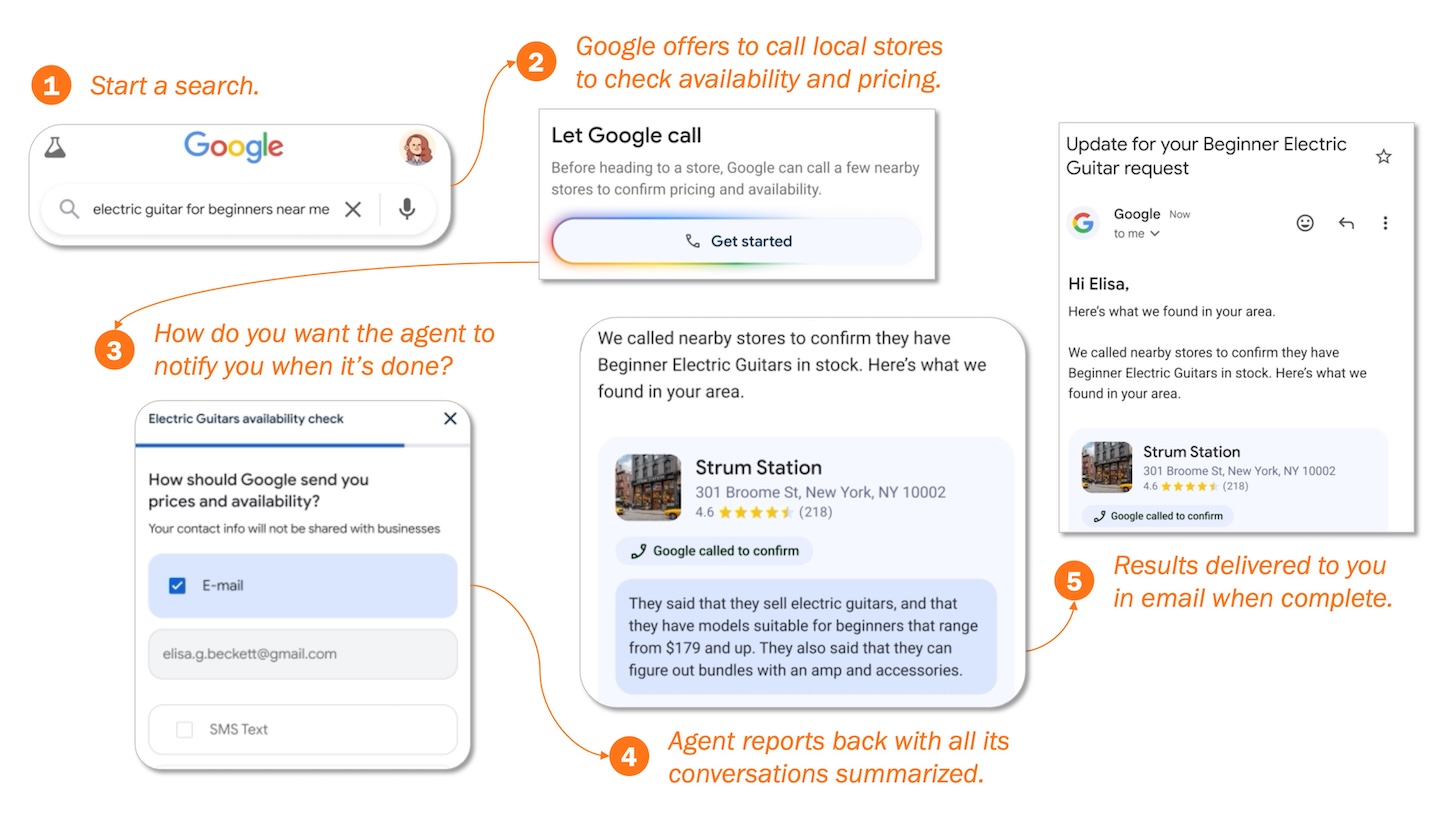
Google is contesting the same ground from a different posture. Its agentic checkout can track a desired purchase until the price falls within a stated budget and then buy automatically with Google Pay, while one option with the Gemini AI agent is to telephone local stores to confirm pricing and availability — placing calls to several shops, questioning the humans who answer on the user's behalf and reporting offers over email.
Q5. What happens to the outbound AI SDR playbook?
Answer: it is being mirrored, and the mirror is unfavourable to sellers. For roughly a year, some B2B sellers have deployed outbound AI SDRs to reach prospects tirelessly and alert a human representative only when the model judges an opportunity promising. The cost borne by human prospects — wading through a stream of nominally personalized yet essentially impersonal emails, texts and calls — was treated as secondary, because the objective was efficiency for reps rather than for customers.
The reversal is literal: the buyer now sits back while an agent calls human salespeople on their behalf. Efficiency lands with the customer, while salespeople absorb a rising volume of incoming agent calls. Hanging up is an option, but it forfeits a possible sale to whichever competitor takes the call. Having agents engage humans in either direction is not efficient, so the report treats this as a brief intermediate state that hastens adoption of agent-to-agent interaction — and poses an unfamiliar question: how to market to and serve AI agents as intelligent intermediaries working on behalf of the audience you intend to reach.
Q6. Why does this become a business-model problem, not just a campaign problem?
Answer: because agent-mediated buying edits both who evaluates you and what you charge for. Gartner stated in July 2026 that up to $234 billion of enterprise application software spend is at risk from agentic artificial intelligence. Bain's Technology Report 2025 makes a narrower argument: seat-based pricing stops matching value once an agent performs the underlying task, so customers increasingly expect to pay for outcomes. BCG reported in October 2026 that 57% of hypergrowth SaaS companies already run hybrid pricing. A vendor calibrated to human buyers therefore faces simultaneous revisions in discovery channel, packaging logic and sales motion.
Q7. Marketer-side versus buyer-side agents: where should the next budget go?
| Decision dimension | Marketer-side agents | Buyer-side agents |
|---|---|---|
| Who deploys it | Your own team, inside existing platforms | The customer, inside a general-purpose assistant |
| Success measured as | Cycle time, output volume, cost per campaign | Share of voice in AI answers, shortlist inclusion, tasks completed on the buyer's behalf |
| Maturity today | Broad — 90.3% of study participants report usage | Early and compounding — just 14% of teams instrument the channel |
| Margin effect | Efficiency first, effectiveness in the best cases | Pressure on packaging, pricing and sales headcount |
| Recommended posture | Keep folding agents into existing workflows | Instrument first, then publish machine-readable facts and endpoints |
Q8. Which seven moves should be decided before the next planning cycle?
- Instrument before you optimise. Add agent-referral and AI-answer detection to analytics, since a channel you cannot see will always be under-funded relative to the 63% who have noticed it.
- Publish machine-readable product facts. Versions, limits, integrations, transparent pricing and proof points in structured form; documentation and changelogs become the front door of the funnel.
- Write an agent contract for sales. Define who answers an agent-initiated call, what data may be disclosed without a human in the loop, and how escalations are logged.
- Open one transactional surface. Expose a single high-intent SKU through checkout, booking or provisioning endpoints so an assistant can act, not merely read.
- Treat AEO tooling as a measurement purchase. Buy it after attribution exists, not as a substitute for building legible assets.
- Rehearse one packaging change. Test outcome-linked or usage-hybrid terms on a segment where an agent does most of the work.
- Set a 90-day funnel review. Use the next 6-12 months window as the checkpoint for reassessing channel mix, not for defending last year's plan.
FAQ: the questions operators ask us first
Is SEO dead now?
No. The ranked channel is being displaced at the entry point, which is why the report frames the loss as one of visibility and control rather than of budget. SEO becomes one input among several answer surfaces.
Do we need an AEO platform this quarter?
Only if you already have instrumentation. The 63% who have adapted content strategy and the 14% who can measure the effect describe the real sequencing problem.
What is the cheapest way to look legible to a buyer's agent?
Structured, unambiguous facts: price, limits, integrations, availability. An agent ignores brand theatrics and consumes data it can verify against a second source.
Should our sales team take calls placed by an agent?
Yes, with a policy. Refusing is the only option that guarantees lost pipeline to a competitor willing to answer.
Does this change how software should be priced?
It applies pressure. When an agent executes the work, per-seat logic weakens — the direction Gartner's $234 billion exposure estimate and Bain's pricing analysis both imply.
What to read, and what GlobalSaaSManager will watch next
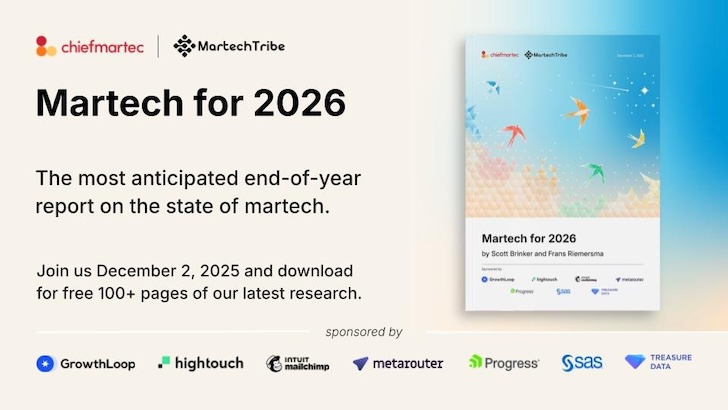
The research itself runs to a 100+ page volume, supported by GrowthLoop, Hightouch, Intuit Mailchimp, MetaRouter, Progress, SAS and Treasure Data, and the full Martech for 2026 report arrives December 2. GlobalSaaSManager's reading for the week after publication: watch which vendors move from AI-answer monitoring to exposing executable endpoints, and which pricing committees concede the first seat-linked concession.
Analysed by Kai Brooks, GlobalSaaSManager SaaSIndustryNews desk. For corrections or a data request from an analyst or procurement team, write to info@globalsaasmanager.com.
Sources referenced
- Martech for 2026 report, release date December 2 — primary source for the 90.3%, 63% and 14% findings and the AI & Data in Marketing study.
- G2 — The Answer Economy research (April 2026)
- G2 — AI reshaping B2B software buyer behaviour (July 2026)
- Gartner — $234 billion of enterprise application software spend at risk from agentic AI
- Gartner — over 40% of agentic AI projects cancelled by end of 2027
- Bain & Company — Will Agentic AI Disrupt SaaS? (Technology Report 2025)
- BCG — SaaS pricing must change as agentic AI reshapes value
- OpenAI — Buy it in ChatGPT: Instant Checkout and the Agentic Commerce Protocol (September 29, 2025)
- Stripe — powering Instant Checkout in ChatGPT